UK annual leave, carry-over and bank holidays: 2027 guide

November 28, 2026


Every UK employer runs into the same annual leave questions as a new leave year approaches: how much holiday part-time and irregular-hours staff have accrued, what carries over into 2027, how bank holidays fit into the statutory minimum and what records have to be kept. Heading into 2027, two details deserve early attention. Since 6 April 2026, employers in Great Britain have a statutory duty to keep holiday and holiday pay records for six years. And because Easter falls in late March 2027 and mid-April 2028, employers on an April-to-March leave year face a 2027/28 leave year with only six bank holidays in England and Wales instead of the usual eight.
This guide sets out the UK statutory annual leave rules for 2027 in plain English: entitlement, bank holidays, carry-over, irregular-hours and part-year accrual, holiday pay, booking notice, leavers, six-year record keeping and where Northern Ireland differs. Every point was checked on 28 November 2026 against the Working Time Regulations 1998, the Employment Rights Act 2025, GOV.UK and Acas.
Key points
- Almost all workers in the UK are entitled to 5.6 weeks of paid annual leave a year from day one, capped at 28 days for anyone working five days a week or more.
- Bank holidays do not have to be given on top of the 5.6 weeks. Watch the 1 April 2027 to 31 March 2028 leave year: it contains no Easter dates, leaving only six bank holidays in England and Wales, which can push a "20 days plus bank holidays" contract below the 28-day legal minimum.
- By agreement, regular-hours workers can carry over up to 1.6 weeks (eight days for a full-time worker) into the next leave year. Longer mandatory carry-over applies to statutory family leave (all 5.6 weeks), sick leave (up to four weeks for 18 months) and cases where an employer failed to encourage leave or warn that unused days will be lost.
- For irregular-hours and part-year workers in Great Britain, statutory leave accrues at 12.07% of hours worked in each pay period, and employers can use rolled-up holiday pay provided it is itemised separately on the payslip. Rolled-up pay remains unlawful for regular-hours staff.
- Since 6 April 2026, employers in Great Britain must keep adequate annual leave and holiday pay records for six years from the date they are made. Failing to do so is a criminal offence.
- Northern Ireland has its own working time regulations: the 5.6-week baseline is the same, but the 2024 Great Britain reforms on 12.07% accrual and rolled-up holiday pay, and the 2026 six-year record-keeping rule, extend to Great Britain only.
1. Statutory annual leave: the 5.6-week baseline
Under regulations 13 and 13A of the Working Time Regulations 1998, almost all workers are entitled to 5.6 weeks of paid annual leave each leave year. That right applies to full-time employees, part-time staff, agency workers, zero-hours workers and people on probation. Genuinely self-employed contractors running their own business are outside it.
In law, the 5.6 weeks is made up of two pots: four weeks of basic leave (regulation 13) and 1.6 weeks of additional leave (regulation 13A). Together they are capped at 28 days a year, no matter how many days a week someone works. Employers can offer more leave in the employment contract, and contractual rules apply to those extra days.
| Working pattern | Calculation | Statutory annual leave |
|---|---|---|
| 5 days a week (full-time) | 5 x 5.6 | 28 days |
| 4 days a week | 4 x 5.6 | 22.4 days |
| 3 days a week | 3 x 5.6 | 16.8 days |
| 2 days a week | 2 x 5.6 | 11.2 days |
| 1 day a week | 1 x 5.6 | 5.6 days |
| 6 days a week | Capped at 28 days | 28 days |
Workers accrue statutory leave from their first day, including during probation, sick leave and statutory family leave such as maternity, paternity, adoption and shared parental leave. If your full-time staff get more than 28 days, part-time staff must get the same enhanced allowance pro rata so they are not treated less favourably.
Part-time calculations often produce part-days, such as 16.8 days. You can never round statutory leave down. Acas guidance notes that during the first year of employment, part-days accrued under the monthly accrual system must be rounded up to the nearest half day; after the first year, you can choose to round up or agree how the worker uses the fraction of a day, such as starting late or finishing early. If staff work fixed weekly hours spread unevenly across days (for example, 30 hours over four days of different lengths), it is cleanest to calculate the entitlement in hours by multiplying the day entitlement by the worker's average working day.
You should state the dates of your leave year in the written contract (most UK employers use 1 January to 31 December or 1 April to 31 March). If no leave year is stated, it runs from the anniversary of the worker's start date. You can check individual calculations quickly with our UK holiday entitlement calculator.
2. 2027 bank holidays and the April-to-March Easter trap
There is no statutory right to take bank holidays off as paid leave on top of the 5.6 weeks. An employer can include bank holidays within the 28-day statutory minimum, offer them on top or require staff to work on a bank holiday and take the paid day off on another date. What matters is the wording of the employment contract.
Because Christmas Day (25 December) and Boxing Day (26 December) fall on Saturday and Sunday in 2027, Monday 27 December and Tuesday 28 December are substitute bank holidays across the whole UK. In Scotland, 2 January falls on a Saturday, so Monday 4 January is also a substitute day. You can also view these dates on our UK bank holidays 2027 page.
| 2027 date | Bank holiday | England and Wales (8) | Scotland (9) | Northern Ireland (10) |
|---|---|---|---|---|
| Friday 1 January | New Year's Day | Yes | Yes | Yes |
| Monday 4 January | 2nd January (substitute day) | No | Yes | No |
| Wednesday 17 March | St Patrick's Day | No | No | Yes |
| Friday 26 March | Good Friday | Yes | Yes | Yes |
| Monday 29 March | Easter Monday | Yes | No | Yes |
| Monday 3 May | Early May bank holiday | Yes | Yes | Yes |
| Monday 31 May | Spring bank holiday | Yes | Yes | Yes |
| Monday 12 July | Battle of the Boyne (Orangemen's Day) | No | No | Yes |
| Monday 2 August | Summer bank holiday (Scotland) | No | Yes | No |
| Monday 30 August | Summer bank holiday | Yes | No | Yes |
| Tuesday 30 November | St Andrew's Day | No | Yes | No |
| Monday 27 December | Christmas Day (substitute day) | Yes | Yes | Yes |
| Tuesday 28 December | Boxing Day (substitute day) | Yes | Yes | Yes |
The 1 April 2027 to 31 March 2028 Easter trap
If your leave year runs from 1 January to 31 December, 2027 has the normal count of bank holidays in every nation. If your leave year runs from 1 April to 31 March, Easter shifts the count sharply across two consecutive years:
- 1 April 2026 to 31 March 2027 contains two Easters (3 and 6 April 2026, plus 26 and 29 March 2027): 10 bank holidays in England and Wales, 11 in Scotland (including the one-off 15 June 2026 World Cup bank holiday) and 12 in Northern Ireland.
- 1 April 2027 to 31 March 2028 contains no Easter dates at all, because Easter 2028 falls in April 2028: only 6 bank holidays in England and Wales (3 May, 31 May, 30 August, 27 December, 28 December 2027 and 3 January 2028), 8 in Scotland and 8 in Northern Ireland.
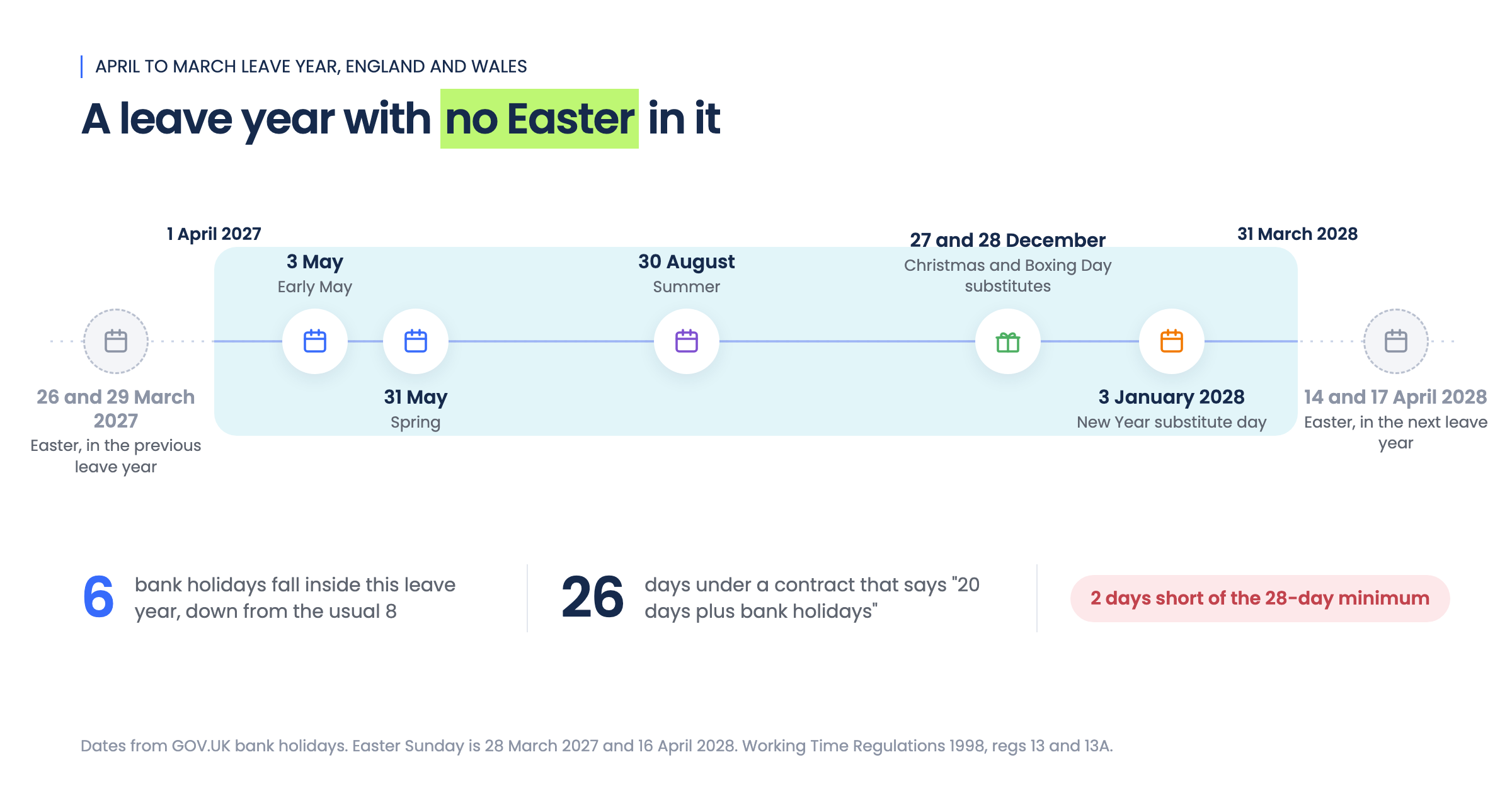
Check your contract wording now if you use an April-to-March leave year. If a full-time contract in England and Wales states "20 days' annual leave plus bank holidays", the employee would receive only 26 days in 2027/28, which is two days below the 28-day statutory minimum. In that case, you must top up the entitlement by two days for 2027/28 so you stay compliant. Contracts written as "28 days including bank holidays" avoid this problem automatically.
3. Carry-over rules: what rolls into 2027 and what expires
As a rule, statutory leave should be taken in the leave year in which it accrues. From 1 January 2024, the Working Time Regulations set out in statute the exact situations in which statutory leave can or must be carried forward.
| Reason for untaken leave | How much carries over (full-time 5-day worker) | Deadline to use it |
|---|---|---|
| Employer and worker agree in contract or policy (regulation 13A(7)) | Up to 1.6 weeks (8 days) of statutory leave, plus any contractual leave above 28 days | Next leave year (or as agreed for extra contractual days) |
| Unable to take leave due to maternity, paternity, adoption, shared parental or other statutory family leave | All untaken statutory leave, up to 5.6 weeks (28 days) | Following leave year |
| Unable to take leave due to sickness | Up to 4 weeks (20 days) for regular-hours workers; up to 28 days for irregular-hours or part-year workers | Within 18 months from the end of the leave year in which it accrued |
| Employer failed to recognise the right to paid leave; did not give a reasonable opportunity or encourage the worker to take it; or failed to warn that untaken days would be lost | Up to 4 weeks (20 days) for regular-hours workers; all accrued statutory leave for irregular-hours or part-year workers | Carries forward until the end of the first full leave year in which the employer puts this right |

That last row is the one most employers overlook before year-end. Under regulation 13(16) and (17), you cannot simply apply a "use it or lose it" cut-off on 31 December if you never reminded staff to book their remaining days or warned them clearly that unused leave will lapse. Before the leave year closes, send a written reminder showing each person's remaining balance, encourage them to book it and state clearly what will expire if left untaken.
4. Irregular-hours and part-year workers: 12.07% accrual and rolled-up pay
For leave years beginning on or after 1 April 2024 in Great Britain, separate statutory rules in regulations 15B to 15F and 16A govern two specific groups of workers:
- Irregular-hours workers: workers whose paid hours in each pay period are, under their contract, wholly or mostly variable (such as many casual or zero-hours staff). Someone on a fixed rotating shift pattern is not an irregular-hours worker just because week one and week two differ.
- Part-year workers: workers who are required under their contract to work only part of the year, with periods of at least one week in which they are not required to work and are not paid (such as term-time or seasonal workers paid only when working).
The 12.07% accrual method
Instead of receiving a fixed annual allowance upfront, irregular-hours and part-year workers accrue statutory annual leave on the last day of each pay period at 12.07% of the hours they worked in that period, capped at 28 days in a leave year. The percentage comes from dividing 5.6 weeks of statutory holiday by the remaining 46.4 working weeks in a 52-week year (5.6 divided by 46.4 equals 12.07%).
Under regulation 15B(5), any fraction of an hour under 30 minutes rounds down to zero, and 30 minutes or more rounds up to one hour:
- A worker on a monthly pay period works 68 hours: 68 x 12.07% = 8.21 hours. Because 0.21 hours (about 13 minutes) is under 30 minutes, they accrue 8 hours of holiday.
- A worker on a weekly pay period works 30 hours: 30 x 12.07% = 3.62 hours. Because 0.62 hours (about 37 minutes) is 30 minutes or more, they accrue 4 hours of holiday.
If a contract gives more than 5.6 weeks of leave, adjust the percentage using the formula leave weeks / (52 - leave weeks) x 100. For example, a contract offering 6 weeks of holiday uses 13.04% (6 divided by 46). During sick leave or statutory family leave, irregular-hours and part-year workers still accrue holiday, calculated by looking back over a 52-week reference period of hours worked before the absence began.
Rolled-up holiday pay
For irregular-hours and part-year workers only, employers in Great Britain can choose to pay rolled-up holiday pay under regulation 16A: adding a 12.07% uplift on top of total pay for work done in each pay period instead of paying holiday pay when the worker takes time off.
To use rolled-up holiday pay lawfully, four rules apply:
- It must be calculated on total normal pay for the period (including shift premiums and regular overtime), not just basic hourly rate, and paid on top of at least the National Minimum Wage.
- It must be paid at the same time as wages and shown as a separate line on the itemised payslip. For example, if a casual worker earns £490.00 in a week (35 hours at £14.00), their payslip shows £490.00 wages plus £59.14 rolled-up holiday pay (12.07%).
- If the worker goes off sick or takes statutory family leave, you must keep paying rolled-up holiday pay each pay period based on their average holiday pay over the previous 52 weeks (or the number of complete weeks they have been paid that way, if fewer than 52).
- Switching existing staff onto rolled-up holiday pay may be a variation of contract, so check contracts and consult staff first. Workers paid rolled-up holiday pay must still be allowed and encouraged to take their actual time off to rest.
Do not use rolled-up holiday pay for regular-hours workers (full-time or part-time). It remains unlawful for anyone outside the irregular-hours and part-year definitions.
5. Holiday pay: normal pay, basic pay and the 52-week reference period
The legal principle under regulation 16 is that a worker should not lose out financially for taking statutory holiday. For regular-hours workers with a fixed salary and no variable pay, a week of holiday is simply paid at their usual weekly wage or salary.
Where workers receive variable elements, regulation 16 splits the 5.6-week statutory minimum into two pay standards:
- 4 weeks (regulation 13) must be paid at the worker's normal remuneration. Since 1 January 2024, regulation 16(3ZA) specifies that this includes commission intrinsically linked to contractual tasks; payments linked to length of service, seniority or professional qualifications; and other payments such as overtime regularly paid in the preceding 52 weeks.
- 1.6 weeks (regulation 13A) can legally be paid at basic pay (though shift premiums that form part of fixed regular shifts still count as basic pay).

For irregular-hours and part-year workers, all statutory leave must be paid at the normal rate (whether via rolled-up holiday pay or when leave is taken). Many employers choose to pay all 5.6 weeks at normal remuneration for regular-hours staff too, rather than tracking two separate pay pots.
Where pay varies from week to week, calculate a week's holiday pay using the worker's average pay over the previous 52 complete paid weeks (a statutory week runs Sunday to Saturday unless weekly pay is calculated to another day). Skip any weeks in which no pay was earned, and for variable elements under regulation 16(3ZA) also skip weeks containing any sick leave or statutory leave, counting further back up to a maximum look-back cap of 104 weeks. If the worker has been employed for fewer than 52 complete weeks, average across the complete paid weeks they have worked.
6. Booking, refusing and requiring leave: statutory notice rules
Regulation 15 sets default notice periods for booking, refusing and directing statutory leave. Your employment contract or holiday policy can set different notice rules, and those contractual rules will apply instead. If the contract is silent, the statutory defaults apply:
| Action | Statutory default notice | Example |
|---|---|---|
| Worker requests leave | Twice the length of leave, plus 1 day | Requesting 5 days' leave: give at least 11 days' notice |
| Employer refuses or cancels leave | The length of leave requested, plus 1 day | Refusing a 10-day request: give at least 11 days' notice |
| Employer requires staff to take leave (such as a Christmas shutdown or during notice) | Twice the length of leave, plus 1 day | Requiring 3 days off over Christmas: give at least 7 days' notice |
Notice is measured before the first day of the leave period (regulation 15 requires notice to be given before the date that is twice or equal to the leave in advance, which is why GOV.UK expresses it as plus one day). While you can refuse a particular date for operational reasons, you cannot stop a worker from taking their statutory entitlement altogether, and you cannot force someone who is off sick to take annual leave.
7. Starters, leavers and payment in lieu
New starters: If someone joins part-way through your leave year, their statutory entitlement for that year is pro-rated to the proportion of the leave year remaining. During the first year of employment, you can either grant the pro-rated year balance upfront or use a monthly accrual system (one-twelfth of the annual entitlement on the first day of each month). Remember that statutory leave accrues throughout a probationary period; our guide to probation periods after 1 January 2027 explains how probation interacts with day-one and six-month rights.
Leavers and payment in lieu: The only time statutory annual leave can be paid in lieu instead of taken is when employment ends (regulation 14). You must pay for any accrued but untaken statutory leave, including carried-over leave from a previous leave year under regulation 14(6), even if the employee is dismissed for gross misconduct.
Unless the contract sets a different (no less generous) formula, regulation 14 calculates the worker's entitlement to the leaving date as (A x B) - C, where A is the full annual statutory entitlement, B is the proportion of the leave year elapsed (measured in calendar days of employment, not working days) and C is the leave already taken.
Worked example (2027): A full-time employee with 28 days' statutory leave on a 1 January to 31 December 2027 leave year (365 days) leaves on 30 June 2027 (181 calendar days into the year). Their accrued leave is 28 x (181 / 365) = 13.88 days. If they have already taken 10 days, you owe payment in lieu for 3.88 days (or 3.9 days if rounded up; never round statutory leave down). You can require a leaving employee to take remaining holiday during their notice period by giving the required statutory or contractual notice; see our UK notice period calculator to check the notice dates.
Overtaken leave: If a leaver has taken more holiday than they accrued by their leaving date, you can only deduct the excess from their final pay if you have a clear prior written agreement (usually a clause in the employment contract) authorising that deduction.
8. Six-year holiday records and Fair Work Agency enforcement
One of the biggest practical changes for UK employers in 2026 is statutory holiday record keeping. Section 35 of the Employment Rights Act 2025 inserted regulation 16B into the Working Time Regulations 1998, which came into force on 6 April 2026 (SI 2026/323). Employers in Great Britain must now:
- keep adequate records demonstrating compliance with statutory annual leave entitlements (including irregular-hours and part-year accrual), holiday pay and payment in lieu on termination; and
- retain those records for at least six years from the date they were made.
The regulations let employers choose the format they reasonably think fit, whether HR software, payroll records or structured spreadsheets. However, failing to keep adequate records for six years is a criminal offence under regulation 29(1) and can result in a fine. Alongside this duty, the government launched the Fair Work Agency on 7 April 2026 to unify state enforcement of minimum wage, statutory sick pay and holiday pay rules. Our Employment Rights Act 2025 timeline tracks how the wider 2026 and 2027 reforms fit together, and our UK employment rates and thresholds from April 2027 guide covers the upcoming pay and SSP figures.
In practice, an email thread or an overwritten annual spreadsheet will not stand up to an inspection four or five years later. Your records should clearly show each worker's leave year, entitlement calculation, dates taken, carry-over approvals, year-end reminders, holiday pay figures (including any 52-week reference calculations or itemised rolled-up holiday pay) and final leaver calculations.
9. Northern Ireland: where the rules differ
Employment law is devolved in Northern Ireland, where annual leave is governed by the Working Time Regulations (Northern Ireland) 2016 rather than the 1998 Great Britain regulations. The 5.6-week (28-day) statutory minimum applies across the UK, and Northern Ireland has 10 bank holidays in calendar year 2027 (8 in an April-to-March 2027/28 leave year).
However, both the 2024 reforms introducing the 12.07% accrual method and rolled-up holiday pay for irregular-hours and part-year workers (SI 2023/1426) and the 6 April 2026 six-year holiday record-keeping duty under regulation 16B (Employment Rights Act 2025, section 35) extend to England, Wales and Scotland only. If you employ staff in Northern Ireland, do not roll out Great Britain rolled-up holiday pay without taking local advice under Northern Ireland law.
10. Year-end employer checklist for 2027
- Send a written year-end reminder before your current leave year closes, showing each worker's remaining balance and explaining clearly what will be lost if not booked (to meet regulation 13(16)).
- Check April-to-March contracts if your leave year runs 1 April to 31 March: confirm whether "20 days plus bank holidays" needs a two-day top-up in England and Wales for 2027/28.
- Audit carry-over balances separately for contractual carry-over (up to 8 statutory days), family leave carry-over (up to 28 days) and sickness carry-over (18-month expiry tracking).
- Review irregular-hours and part-year workers in Great Britain: verify 12.07% accrual calculations (or enhanced contractual percentage) and check that any rolled-up holiday pay is itemised separately on payslips.
- Check holiday pay components for staff earning regular commission, overtime or status allowances so the four-week normal pay requirement is met using the 52-week paid reference period.
- Confirm contractual deduction clauses are in place in writing before recovering overtaken leave from a leaver's final pay.
- Verify six-year record retention so historical leave balances, approvals and holiday pay figures are archived cleanly rather than overwritten each January.
- Load 2027 regional bank holidays accurately if you employ staff across England and Wales, Scotland and Northern Ireland.
11. If you also employ people in Türkiye
Annual leave works differently if your group also has a team in Türkiye. Under article 53 of the Turkish Labour Act No. 4857, employees do not accrue usable statutory leave from day one: the right starts after one full year of service and then rises with tenure to 14 working days (one to five years), 20 working days (more than five and under 15 years) and 26 working days (15 years or more), with a 20-day minimum for employees aged 18 or under, or 50 or over.
Türkiye's 15.5 public holiday days a year are completely separate from annual leave and are not deducted if they fall inside a holiday period. As in the UK, unused statutory leave is paid out only when employment ends (article 59). Our guide to employing people in Türkiye compares leave, working time and payroll side by side with the UK, and our Türkiye payroll and HR page explains how we run Turkish teams locally.
12. How Kolay IK helps
Kolay IK does not run UK PAYE payroll; it works alongside your UK payroll provider or accountant by exporting payroll-ready leave and timesheet reports each month. On the HR side, it replaces the holiday spreadsheet and keeps the audit trail you now need for six years:
- Leave Management calculates balances, accruals and future-dated leave automatically and lets you set separate leave types and entitlement rules by country or entity. Requests move through multi-stage approval workflows where managers can see who else in the department is already off, and payroll reconciliation reports export cleanly at month-end.
- Employee Management stores employee records, contracts and historical leave records in one place, so past leave years stay archived instead of being overwritten.
- Shift & Rota shows approved leave alongside staff availability when building rotas, so gaps in cover are spotted before shifts go out.
For a wider look at the platform, read our full Kolay IK product tour or try our free holiday entitlement calculator and 2027 UK bank holidays calendar. More than 2,600 companies use Kolay IK, and if you also employ staff in Türkiye, the same platform handles Turkish leave rules and local payroll.
See how it fits your leave year in a short demo, or contact us with a question.
Frequently asked questions
How many days' annual leave is a full-time UK employee entitled to in 2027?
At least 5.6 weeks of paid annual leave, which is 28 days for someone working five days a week. Statutory leave is capped at 28 days even if someone works six days a week. Bank holidays can be included inside those 28 days or given on top, depending on the contract.
Why do April-to-March employers need to watch 2027 bank holidays?
Easter falls on 26 and 29 March 2027 and then not again until April 2028. That leaves the 1 April 2027 to 31 March 2028 leave year with only six bank holidays in England and Wales (eight in Scotland and Northern Ireland). A full-time contract in England and Wales giving "20 days plus bank holidays" would drop to 26 days unless topped up by two days to meet the 28-day statutory minimum.
How much holiday can an employee carry over into 2027?
If your contract or policy allows it, a full-time worker can carry over up to 1.6 weeks (eight days) of statutory leave, plus any contractual leave above 28 days. Workers unable to take leave due to maternity or other statutory family leave can carry over all 5.6 weeks (28 days) into the next year, and workers off sick can carry over up to four weeks (20 days for regular-hours staff, or up to 28 days for irregular-hours and part-year staff) to use within 18 months.
Can I still use rolled-up holiday pay in 2027?
In Great Britain, yes for irregular-hours and part-year workers only (a 12.07% uplift on total pay, paid with wages and shown as a separate line on the payslip). Rolled-up holiday pay remains unlawful for regular-hours workers, and the 2024 Great Britain reform does not apply in Northern Ireland.
Can I pay an employee for untaken holiday instead of letting them take it?
Not for statutory leave while they remain employed. Payment in lieu of statutory annual leave is only allowed when employment ends (including on dismissal for gross misconduct). Separate rules can be agreed in the contract for extra contractual leave above 5.6 weeks.
How long do UK employers have to keep annual leave records?
Since 6 April 2026, employers in Great Britain must keep adequate records showing compliance with statutory annual leave and holiday pay rules for at least six years from the date the records are made (Working Time Regulations 1998, regulation 16B).
Do part-time staff get bank holidays?
Part-time workers cannot be treated less favourably than full-time workers. Most employers include bank holidays in a single pro-rata holiday pot (for example, 16.8 days for someone working three days a week) and deduct a day only when a bank holiday falls on a day the worker would normally work.
Sources
Checked on 28 November 2026 against the following official legislation and guidance.
- The Working Time Regulations 1998, regulations 13, 13A, 14, 15, 15B, 16, 16A and 16B (legislation.gov.uk)
- The Employment Rights (Amendment, Revocation and Transitional Provision) Regulations 2023, SI 2023/1426 (legislation.gov.uk)
- Employment Rights Act 2025, section 35: duty to keep records relating to annual leave (legislation.gov.uk)
- Holiday entitlement (GOV.UK)
- Holiday pay and entitlement reforms from 1 January 2024 (Department for Business and Trade, GOV.UK)
- UK bank holidays (GOV.UK)
- Holiday entitlement (Acas, updated 1 October 2026)
Important: this guide is not legal advice
This guide gives general information about statutory annual leave and holiday pay in the UK. It is not legal, tax or payroll advice, and employment rules differ across Great Britain and Northern Ireland. Before you act on a specific case, especially a contract variation, rolled-up holiday pay switch or complex holiday pay calculation, speak to an employment solicitor or payroll specialist who can look at your circumstances.
If you would like to talk any of this through, you can contact us at any time.