Employment Rights Act 2025: 2026-2027 implementation timeline for UK employers

November 25, 2026


The Employment Rights Act 2025 received Royal Assent on 18 December 2025. It is the largest change to UK employment law in a generation, and almost none of it took effect on that day. A handful of sections started on Royal Assent or two months later. Everything else starts only when the government makes commencement regulations, so the Act arrives in stages from April 2026 to the end of 2027, and some of it still has no date at all.
That makes the date, not the headline, the thing employers need. This guide puts every measure on one timeline: what is already in force, what arrives on 1 January 2027, what follows during 2027 and what is still waiting for a consultation response. For each stage it says what a UK employer should change, and which of our free HR calculators help with the numbers. Every date was checked on 25 November 2026 against the government's implementation timetable (last updated 5 November 2026), the commencement regulations on legislation.gov.uk and Acas guidance.
In this guide
- The timeline at a glance
- Already in force in 2026
- Statutory Sick Pay from day one
- Tribunal claims and harassment
- Unfair dismissal from 1 January 2027
- The rest of 2027
- Zero hours work: no date yet
- The figures to use alongside
- An employer checklist
- If you also employ people in Türkiye
- How Kolay IK helps
Key points
- The Act is law (2025 c. 36), but most of it starts through separate commencement regulations. Six sets have been made so far.
- Since 6 April 2026, Statutory Sick Pay is paid from the first day of sickness with no lower earnings limit, and paternity leave and unpaid parental leave are day-one rights.
- Since 1 October 2026, most employment tribunal claims can be brought within six months instead of three. Since 30 October 2026, employers must take all reasonable steps to prevent sexual harassment, including by third parties.
- From 1 January 2027, the qualifying period for unfair dismissal falls from two years to six months and the cap on the compensatory award is removed.
- Fire and rehire restrictions follow in March 2027, bereavement leave and mandatory action plans for employers with 250 or more workers in April 2027, and stronger flexible working and pregnancy protections in October 2027.
- Guaranteed hours and shift notice for zero hours workers have no commencement date yet.
1. The timeline at a glance
The Act extends mainly to England, Wales and Scotland. Northern Ireland sets its own employment law, with one exception that matters for payroll: the Statutory Sick Pay changes also apply there.
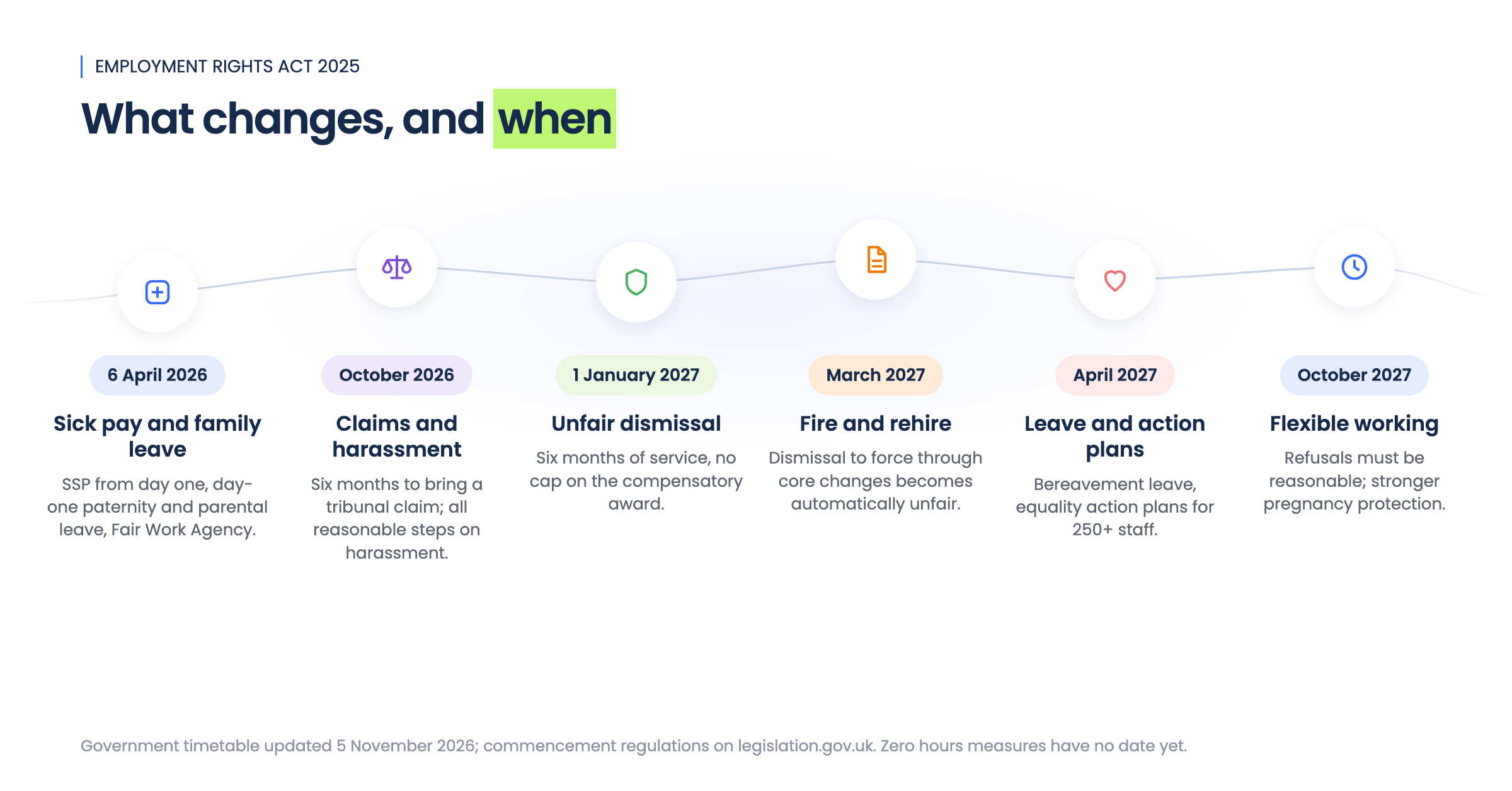
| Date | What changes | Status |
|---|---|---|
| 6 April 2026 | SSP from day one, no lower earnings limit; day-one paternity leave and unpaid parental leave; protective award up to 180 days; whistleblowing on sexual harassment; holiday records kept for six years | In force |
| 7 April 2026 | Fair Work Agency established | In force |
| 1 October 2026 | Six months to bring most tribunal claims | In force |
| 30 October 2026 | All reasonable steps to prevent sexual harassment; third-party harassment; union right of access | In force |
| 1 January 2027 | Unfair dismissal after six months, no compensatory cap; written statement of the right to join a union; tipping consultation duty | Regulations made |
| March 2027 | Fire and rehire restrictions | Planned |
| April 2027 | Bereavement leave, including pregnancy loss; mandatory equality action plans for 250+ workers; collective redundancy threshold counted across the whole organisation | Planned |
| October 2027 | Flexible working refusals must be reasonable; stronger protection for pregnant women and new mothers | Planned |
| No date | Guaranteed hours, shift notice and cancellation pay for zero hours workers | Awaiting consultation response |
"Regulations made" means the commencement regulations are already on legislation.gov.uk with a fixed date. "Planned" means the date comes from the government's timetable and the regulations are still to be made, so it can move. Two dates already have: fire and rehire was first expected in October 2026, then January 2027, and is now planned for March 2027.
2. Already in force in 2026
If your policies have not been reviewed since the spring, these are the changes they may be missing.
- Paternity leave and unpaid parental leave from day one (6 April 2026). The service requirements for the leave were removed. Statutory Paternity Pay still has its own service and earnings conditions, so an employee can now be entitled to the leave without being entitled to the pay. Our maternity leave calculator works out the key dates for the related maternity rights.
- Collective redundancy protective award (6 April 2026). The maximum award for failing to consult when proposing 20 or more redundancies at one establishment within 90 days doubled from 90 to 180 days' pay. Our redundancy pay calculator covers the statutory redundancy payment for each employee.
- Whistleblowing on sexual harassment (6 April 2026). A disclosure about sexual harassment is now a protected disclosure in its own right.
- Holiday records (6 April 2026). Employers must keep records showing they have met their annual leave and holiday pay duties, for six years. The holiday entitlement calculator helps with the entitlement itself; the records are what an inspector will ask for.
- Voluntary action plans (6 April 2026). Large employers can publish gender equality and menopause action plans now; they become mandatory in 2027.
- Fair Work Agency (7 April 2026). A single enforcement body for minimum wage, SSP, holiday pay and agency work rules. Holiday pay is enforced by the state for the first time, which is why the record-keeping duty matters.
- Trade unions (February to October 2026). Most of the Trade Union Act 2016 has been repealed, electronic balloting is available for statutory ballots since 25 August 2026, and unions have a statutory route to access workplaces since 30 October 2026.
3. Statutory Sick Pay from day one
The sick pay change is the one that reached every payroll. From 6 April 2026 the three waiting days went, so SSP is paid from the first qualifying day of sickness, and the lower earnings limit went too, so lower-paid employees who previously got nothing now qualify. The rate is £123.25 a week or 80% of the employee's average weekly earnings, whichever is lower. The same change applies in Northern Ireland.

Two practical effects follow. Short absences now cost something from the first day, so one-day absences become visible in payroll in a way they were not before. And the 80% rule means payroll has to know average weekly earnings for low earners rather than paying a flat rate. Our Statutory Sick Pay calculator applies the new rules, and the Bradford Factor calculator shows where frequent short absences are adding up. The government has proposed £127.55 a week from April 2027, subject to the uprating order being approved.
4. Tribunal claims and harassment
Six months to claim. Since 1 October 2026, the time limit for most employment tribunal claims is six months (in practice six months less one day) instead of three. It applies where the act complained of, or the dismissal, is on or after 1 October 2026; Acas early conciliation still comes first and still pauses the clock. Employers should expect claims to arrive later after a dismissal, and should keep files, notes and messages for longer before archiving them.
Preventing sexual harassment. Since 30 October 2026, the existing duty to take reasonable steps to prevent sexual harassment has become a duty to take all reasonable steps, and employers must not permit harassment of their staff by third parties such as customers, clients or contractors. The government can set out specific steps in regulations later; until then, a written policy, training, a clear way to report, and a recorded risk assessment are the evidence a tribunal will look for. From September 2027, regulations are planned to limit non-disclosure agreements in harassment and discrimination cases.
5. Unfair dismissal from 1 January 2027
This is the change most employers will feel. Where the effective date of termination is on or after 1 January 2027, an employee needs six months of continuous service, not two years, to claim ordinary unfair dismissal. At the same time the cap on the compensatory award is removed. The government first proposed a day-one right; the six-month period was a compromise agreed before Royal Assent, and it can now be changed only by primary legislation.

Three things need attention before the new year.
- Probation. A probation period longer than six months no longer protects the employer in the way it did. Review new starters at three and five months, record the outcome, and make decisions before the six-month point. Our guide to probation periods after 1 January 2027 sets out the calendar and the real deadline.
- Dismissals in progress. The date that counts is the effective date of termination, which includes the notice period. A notice given in December that ends in January falls under the new rules. Our notice period calculator shows when notice given today will end.
- Process and records. With no cap on compensation, a fair reason and a fair, documented process matter more for every employee past six months, especially senior and highly paid staff. The staff turnover calculator helps you see how many leavers fall inside the first two years, which is the group now covered.
Dismissals for automatically unfair reasons, such as whistleblowing, pregnancy or asserting a statutory right, still need no qualifying service at all.
6. The rest of 2027
- 1 January 2027: union statement and tipping. Employers must tell workers in writing that they have the right to join a trade union, in the form set by the government. Employers that receive tips must consult staff on their tipping policy and review it at least every three years.
- March 2027: fire and rehire. Dismissing an employee for refusing to agree to a change to certain core terms, such as pay, hours or holiday, or replacing them with someone on the new terms, will be automatically unfair in most cases. There is a narrow exception where the employer is in serious financial difficulty and the change is unavoidable.
- April 2027: bereavement leave. A new day-one right to unpaid bereavement leave, including for pregnancy loss.
- April 2027: action plans. Employers with 250 or more workers must publish gender equality and menopause action plans, alongside their gender pay gap report. Public authorities start in March 2027.
- April 2027: collective redundancy. The threshold for collective consultation will be counted across the whole organisation, not only at one establishment, so a business making redundancies across several sites can trigger the duty where it did not before.
- October 2027: flexible working. An employer can still refuse a request, but only for one of the listed business reasons and only where the refusal is reasonable, with an explanation to the employee. Acas is consulting on a new code of practice until 17 December 2026.
- October 2027: pregnancy and new mothers. Stronger protection from dismissal during pregnancy, maternity leave and a period after return.
- December 2027: umbrella companies. Umbrella companies come under the regulation that applies to employment agencies.
7. Zero hours work: no date yet
The Act gives workers on zero or low hours contracts a right to be offered guaranteed hours reflecting the hours they regularly work, reasonable notice of shifts, and pay when a shift is cancelled or cut at short notice. These are among its best-known measures, but the detail sits in regulations. The government consulted from 2 June 2026, with a 12-week reference period as its preferred option, and had not published its response or a commencement date by 25 November 2026. Employers that rely on variable hours should map who works regular patterns now; our pro rata salary calculator helps price a fixed-hours offer against current pay.
8. The figures to use alongside
The Act changes the rules; the annual uprating changes the numbers. These are the figures employers will use with it.
| Figure | From April 2026 | From April 2027 |
|---|---|---|
| National Living Wage (21 and over) | £12.71 an hour | £13.21 an hour |
| 18 to 20 year olds | £10.85 an hour | £11.27 an hour |
| Statutory Sick Pay | £123.25 a week or 80% of earnings | £127.55 a week or 80% of earnings (proposed) |
| Statutory paternity, maternity and shared parental pay (standard rate) | £194.32 a week or 90% of earnings | £201.11 a week or 90% of earnings (proposed) |
The 2027 minimum wage rates were announced on 28 October 2026. The 2027 sick pay and family pay rates were proposed on 11 November 2026 and still need parliamentary approval. To see what the new rates mean for a full employment cost, including National Insurance and pension, use our employee cost calculator, and plan leave around the 2027 bank holidays. Our page on UK employment rates and thresholds from April 2027 has the full set of figures.
9. An employer checklist
- Check payroll pays SSP from day one at the lower of the flat rate or 80% of earnings, for every employee including low earners.
- Update the family leave policy: paternity leave and unpaid parental leave from day one, and bereavement leave from April 2027.
- Confirm holiday records go back far enough and will be kept for six years.
- Rewrite the harassment policy for the all reasonable steps duty and third parties, train managers, and record a risk assessment.
- Set probation reviews so that decisions are made well before six months of service.
- For any dismissal with an effective date in 2027, follow a full fair process, whatever the length of service.
- Keep employee files and correspondence long enough for a six-month claim window.
- Prepare the written statement of the right to join a union for 1 January 2027.
- Stop any plan to change core terms by dismissal and re-engagement before March 2027 and take advice.
- If you have 250 or more workers, start the gender equality and menopause action plans now.
10. If you also employ people in Türkiye
For a UK business with a team in Türkiye, several of these reforms move UK law towards rules Türkiye has had for years, with important differences in the detail.
| Topic | United Kingdom | Türkiye |
|---|---|---|
| Protection from dismissal | Unfair dismissal after six months from 1 January 2027, any employer size | Job security after six months, where the employer has 30 or more employees and the contract is indefinite |
| Remedy | Compensation, uncapped from 1 January 2027 | Reinstatement within one month, or four to eight months' pay, plus up to four months' idle-time pay |
| Time to bring a claim | Six months, after Acas early conciliation | One month to apply to a mediator, which is mandatory, then the labour court |
| Paternity leave | One or two weeks, from day one since April 2026 | Ten days paid by the employer, since 1 May 2026 |
| Sick pay | SSP paid by the employer from day one | SGK pays an allowance from the third day of sickness |
| Written termination | A written reason on request | Notices in writing against signature, or by registered electronic mail (KEP) with consent |
The practical lesson is the same in both countries: a dismissal now needs a documented reason and process much earlier in employment than UK managers are used to. Our guides to employing people in Türkiye and ending employment in Türkiye cover the Turkish side in full, and the Türkiye employee cost calculator shows what a Turkish salary costs the employer.
11. How Kolay IK helps
Kolay IK is HR software used by more than 2,600 companies to run leave, records, performance and people data in one place. Applied to this timeline:
- Leave Management lets you add new leave types such as day-one paternity leave and bereavement leave with your own rules, and keeps every request and approval on record.
- Employee Management keeps contracts, policies and documents for each employee in one file, with reminders for important dates such as the end of probation.
- Performance Review gives you documented probation and performance reviews, which is the evidence a fair process now needs from six months.
- Announcements sends policy updates, such as a new harassment policy or the union statement, to everyone by email, Feed and push notification.
- HR Analytics shows headcount, absence and turnover in one place, so you can see where leavers and absence concentrate.
See how Kolay IK works for your team in a short demo.
Frequently asked questions
When does the Employment Rights Act 2025 come into force?
The Act received Royal Assent on 18 December 2025, but it comes into force in stages through commencement regulations. The first changes started on 18 February and 6 April 2026, the unfair dismissal changes start on 1 January 2027, and most of the remaining measures are planned for 2027. Guaranteed hours for zero hours workers have no date yet.
When does the unfair dismissal qualifying period change to six months?
On 1 January 2027. The new rules apply where the effective date of termination is on or after that date, which includes any notice period. The same change removes the cap on the compensatory award. The regulations making the change were made in May 2026.
Is Statutory Sick Pay now paid from the first day?
Yes. Since 6 April 2026 there are no waiting days and no lower earnings limit. The weekly rate is £123.25 or 80% of the employee's average weekly earnings, whichever is lower.
Is paternity leave a day-one right?
Yes, since 6 April 2026, as is unpaid parental leave. Statutory Paternity Pay still depends on service and earnings conditions, so some employees will be entitled to the leave but not the pay.
How long does an employee have to bring a tribunal claim?
Six months for most claims where the act complained of is on or after 1 October 2026, instead of three months before. Acas early conciliation is still required first and extends the time limit while it runs.
Does the Employment Rights Act 2025 apply in Northern Ireland?
Mostly not. The employment rights parts extend to England, Wales and Scotland. The Statutory Sick Pay changes are the main exception and apply in Northern Ireland too; Northern Ireland is reforming the rest of its employment law separately.
Sources
Dates and figures were checked on 25 November 2026 against: the Employment Rights Act 2025 (2025 c. 36) on legislation.gov.uk, including section 158 (extent) and section 159 (commencement); the commencement regulations SI 2026/3, 2026/323, 2026/373, 2026/559, 2026/954 and 2026/1065; the GOV.UK publication "Implementing the Plan to Make Work Pay and Employment Rights Act" (timeline last updated 5 November 2026); Acas guidance on the Employment Rights Act 2025 (updated 12 November 2026); GOV.UK pages on Statutory Sick Pay, paternity pay and the National Minimum Wage; "Minimum wage rates for 2027" (28 October 2026); and the DWP's proposed benefit and pension rates for 2027 to 2028 (11 November 2026). Planned dates can change until the regulations are made.
Official texts and guidance used for this guide:
- Employment Rights Act 2025, c. 36 (legislation.gov.uk)
- Plan to Make Work Pay and Employment Rights Act: timeline update (GOV.UK, updated 5 November 2026)
- Employment Rights Act 2025 (Acas guidance, updated 12 November 2026)
- Statutory Sick Pay (GOV.UK)
- Paternity pay and leave: eligibility (GOV.UK)
- National Minimum Wage and National Living Wage rates (GOV.UK)
- Minimum wage rates for 2027 (GOV.UK, 28 October 2026)
- Proposed benefit and pension rates 2027 to 2028 (DWP, GOV.UK, 11 November 2026)
- Labour Act No. 4857 (official consolidated text, mevzuat.gov.tr)
Important: this guide is not legal or payroll advice
This guide gives general information about UK employment law and payroll, with a short comparison with Türkiye. It is not legal, tax or payroll advice, and the dates and figures in it change as regulations are made. Before you act, discuss employment law questions with a qualified employment solicitor and payroll questions with your accountant or payroll adviser; for Türkiye, with a Turkish employment lawyer and a certified public accountant (mali müşavir).
If you would like to talk any of this through, you can contact us at any time.