Social security (SGK) in Türkiye: employer guide

November 24, 2026


In the UK, an employer meets social security mainly through National Insurance, with auto-enrolment into a workplace pension alongside it and the NHS funded from general taxation. In Türkiye all of this runs through one institution and one law. The Social Security Institution (Sosyal Güvenlik Kurumu, SGK) collects the premiums, registers every employee, pays sickness and maternity allowances, runs the public pension and funds healthcare. Most of it rests on a single statute, the Social Insurance and General Health Insurance Law No. 5510.
One law sounds simple. In practice, SGK touches almost every other law an employer deals with, from the Labour Act and the Income Tax Act to severance pay, private pensions, health and safety and data protection, and its rules change several times a year. This guide goes through Turkish social security in order: what it is, who it covers, what it pays for, what it costs, what the employer has to do at each stage of employment, and how it connects to the rest of Turkish law. For the wider picture, start with our guide to employing people in Türkiye. Every figure is for 2026 and was checked on 24 November 2026 against the official consolidated texts.
In this guide
- What social security means in Türkiye
- Who is covered
- What SGK pays for
- What it costs: the 2026 premium rates
- What premiums are charged on
- SGK from first day to last
- How SGK connects to other laws
- Why it is complicated
- Mistakes UK employers make
- How Kolay IK helps
- Turkish terms you will meet
Key points
- Turkish social security is run by one institution, SGK, under one main law, No. 5510. It covers pensions, healthcare, sickness, maternity, work accidents and, through a separate law, unemployment.
- In 2026 the employee pays 15% of gross pay and the employer 23.75%, reduced to 21.75% in most sectors (18.75% in manufacturing) for employers that file and pay on time and owe SGK nothing.
- Premiums are charged on monthly earnings between TRY 33,030 and TRY 297,270. Bonuses count, and the part above the ceiling carries forward for up to two months.
- Every employee is registered with SGK before their first day, and every month's pay and working days are reported in one combined return with the tax office by the 26th of the following month.
- SGK rules interact with at least a dozen other laws, and the main parameters change every January and some every July. Laws passed in December 2025 and April 2026 alone changed the employer's pension rate, the premium reduction and the list of benefits exempt from premiums.
- Kolay IK calculates premiums, prepares SGK notifications and calculates the incentives you are entitled to inside payroll, at no extra fee for incentives.
1. What social security means in Türkiye
Until 2008, Türkiye had three separate schemes: one for private-sector employees (SSK), one for the self-employed (Bağ-Kur) and one for civil servants (Emekli Sandığı). Law No. 5510, in force since 1 October 2008, brought them together under SGK with largely common rules. That is why Turkish payroll staff still sometimes say "SSK" when they mean social security for employees.
For a UK reader the useful comparison is this. National Insurance gives entitlement to the State Pension and some benefits, healthcare comes from the NHS, statutory sick pay and maternity pay are paid by the employer, and a workplace pension sits on top. In Türkiye the SGK premium buys all of the state layer at once: a pension, healthcare for the employee and their dependants, and allowances for sickness, maternity and work accidents that SGK itself pays to the employee. Unemployment insurance is a separate law, No. 4447, but SGK collects it with the other premiums. The private pension layer is automatic enrolment under Law No. 4632, where the employee contributes and the employer only deducts and transfers.
2. Who is covered
Law No. 5510 puts every insured person into one of three groups, named after the paragraphs of article 4 that define them. You will see these labels on every SGK document.
| Status | Who | What it means for you |
|---|---|---|
| 4/a | People working under an employment contract for one or more employers | Your employees. You register them, deduct their share and pay both shares. |
| 4/b | The self-employed, including company partners in some cases and board members who are shareholders | A Turkish director or partner may be insured on their own account rather than through payroll. |
| 4/c | Civil servants | Rarely relevant to private employers. |
Coverage does not depend on nationality. A foreign employee working in Türkiye under an employment contract is insured under 4/a like anyone else, and also needs a work permit under the International Labour Force Law No. 6735. The UK and Türkiye signed a Convention on Social Insurance in 1959. Whether it lets an employee seconded from the UK stay in UK National Insurance instead of SGK depends on its terms and on current HMRC practice, so check with HMRC before you assume it does.
3. What SGK pays for
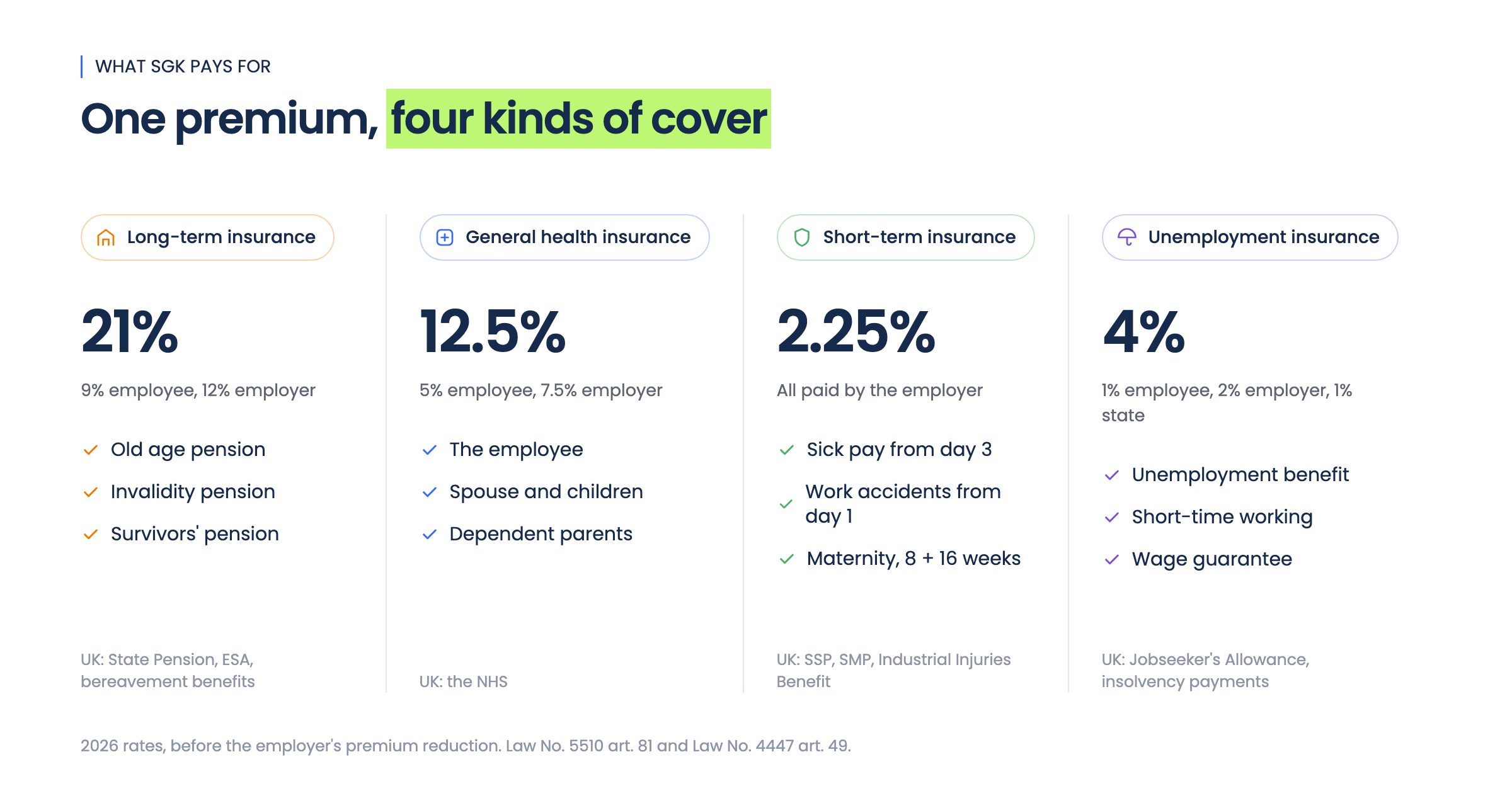
Law No. 5510 groups the benefits into branches, each funded by its own slice of the premium.
| Branch | What it pays | Closest UK reference |
|---|---|---|
| Short-term insurance (kısa vadeli sigorta) | Allowances during temporary incapacity after a work accident, an occupational disease or sickness, maternity allowance, and pensions for permanent incapacity from a work accident | Statutory Sick Pay, Statutory Maternity Pay, Industrial Injuries Disablement Benefit |
| Long-term insurance (uzun vadeli sigorta) | Old age, invalidity and survivors' pensions | State Pension, Employment and Support Allowance, bereavement benefits |
| General health insurance (genel sağlık sigortası, GSS) | Healthcare for the employee, their spouse, children up to 18 (20 in secondary education, 25 in higher education) and dependent parents | The NHS |
| Unemployment insurance (işsizlik sigortası, Law No. 4447) | Unemployment benefit, short-time working allowance, wage guarantee on insolvency | Jobseeker's Allowance, the insolvency payments scheme |
Three details matter for employers. First, SGK pays the sickness allowance from the third day of incapacity, provided the employee has 90 days of short-term premiums in the previous year; it is two-thirds of daily earnings for outpatient treatment and half for inpatient treatment. After a work accident it is paid from the first day. SGK pays nothing for the first two days of sickness. For employees on a fixed monthly salary, the Court of Cassation has held that sick days cannot simply be deducted from pay and only the SGK allowance can be offset, so the safer course is to pay those two days; for daily or hourly paid employees it depends on the contract or a collective agreement. Second, SGK pays maternity allowance for eight weeks before and sixteen weeks after birth, again subject to 90 days of premiums in the previous year. Third, unemployment benefit is 40% of the employee's average gross earnings over the last four months, capped at 80% of the gross minimum wage, for 180, 240 or 300 days depending on whether the employee has 600, 900 or 1,080 days of premiums in the last three years, and only if they were under an employment contract for the whole of the last 120 days and the contract ended for a reason the law accepts.
On pensions, an employee first insured after 30 April 2008 qualifies for an old age pension with 7,200 days of premiums and a minimum age that is 58 for women and 60 for men today and rises step by step from 2036 to 65 for both from 2048. People first insured earlier have different, often much earlier, conditions. This matters to you because of severance pay, explained below.
4. What it costs: the 2026 premium rates
Premiums are a percentage of the employee's premium base (prime esas kazanç), which is close to, but not the same as, gross pay.
| 2026 rates | Employee | Employer |
|---|---|---|
| Long-term insurance (pensions) | 9% | 12% |
| General health insurance | 5% | 7.5% |
| Short-term insurance | 0% | 2.25% |
| Unemployment insurance | 1% | 2% |
| Total | 15% | 23.75% |

The employer's pension share rose from 11% to 12% on 1 January 2026, under Law No. 7566. The same law cut the reduction most private employers receive on the employer's share from four points to two; it had already fallen from five to four in February 2025 under Law No. 7538. Manufacturing keeps five points until 31 December 2026 unless it is extended. The reduction is paid by the Treasury and is not automatic. You only get it if every return is filed on time, every premium is paid on time and you have no overdue premiums, fines or late payment interest at SGK. The state also adds one percentage point of its own to unemployment insurance.
For a gross salary of TRY 100,000 a month at a non-manufacturing employer that qualifies for the reduction, the employer pays TRY 21,750 in premiums and the employee TRY 15,000, so SGK receives TRY 36,750 for that employee every month. For comparison, a UK employer pays 15% National Insurance on earnings above £5,000 a year and at least 3% of qualifying earnings into a workplace pension.
5. What premiums are charged on
UK National Insurance is charged on earnings, with a long list of rules on what counts. Türkiye has the same idea, set out in article 80 of Law No. 5510, and it was rewritten in April 2026 by Law No. 7577.
The premium base includes wages earned in the month, and bonuses, premiums and similar payments made in the month. Employer payments into private health insurance and private pensions count too, above the limit described below. Any payment not on the exemption list counts, whatever it is called, and cash paid in place of a benefit in kind counts.
The following are exempt from premiums:
- benefits in kind;
- death, birth and marriage grants;
- travel allowances for business trips;
- severance pay, notice pay and similar lump sums on termination;
- child and family allowances, up to amounts SGK sets each year;
- employer payments into the employee's own private health insurance and private pension, up to 30% of the minimum wage a month in total (premiums paid for family members count in full);
- a meal allowance paid in cash, on a meal card or by voucher, where no meal is provided at the workplace, up to TRY 300 a day worked (from 17 April 2026; TRY 158 before). This amount rises every year with the revaluation rate.

One sentence in article 80 explains a lot of Turkish payroll errors: exemptions from premiums in other laws do not apply to SGK. A payment that is exempt from income tax can still attract premiums, and the other way round. The meal allowance shows how the two can drift apart: until 17 April 2026 the daily limit was TRY 158 for SGK but TRY 300 for income tax, and Law No. 7577 only then aligned them at TRY 300.
Premiums are charged between a floor and a ceiling. In 2026 the floor is the minimum wage, TRY 33,030 a month or TRY 1,101 a day, and the ceiling is nine times the floor, TRY 297,270 a month. Below the floor, premiums are charged on the floor. Wages are allocated to the month they were earned. Other payments, such as a bonus, go into the month they are paid, and any part that cannot be charged because the ceiling is reached is carried forward and added to the next two months, as far as those months are below the ceiling. A large annual bonus can therefore change the premiums for three months.
The monthly return also reports a number of premium days, normally 30. If an employee works fewer days, the return must give a reason code for the missing days, such as unpaid leave, sickness or a strike, and the employer must be able to support it. Unexplained missing days are one of the first things an SGK inspector looks at.
6. SGK from first day to last
Most of an employer's SGK duties follow the employment from start to finish.

- Register the workplace. Before the first employee starts, the employer submits a workplace registration (işyeri bildirgesi) and receives an SGK workplace registration number. For companies, registration with the trade registry is passed to SGK automatically. The workplace's economic activity code decides, among other things, whether the manufacturing reduction applies.
- Register each starter before day one. The starter notice (sigortalı işe giriş bildirgesi) must reach SGK before the insurance start date, in practice no later than the day before the employee starts. Construction, fishing and agriculture can report on the day work starts. A late notice costs an administrative fine equal to the monthly minimum wage for each employee, and twice that if an inspection or another authority discovers the employee first.
- Report and pay every month. The employer files the combined income tax and social security return (Muhtasar ve Prim Hizmet Beyannamesi, MUHSGK) for each month by the 26th of the following month, and pays the SGK premiums by the end of that month. Incentives are claimed in the same return.
- Handle sickness and accidents. Medical reports issued to employees reach the employer through SGK's online system, and the employer confirms whether the employee worked on those days so that SGK can pay the allowance. A work accident is reported to the police immediately and to SGK within three working days. An occupational disease is reported to SGK within three working days of the employer learning of it.
- Report the leaver. When employment ends, the employer submits a leaver notice (işten ayrılış bildirgesi) within ten days, with a reason code. The code matters to the employee, because it decides whether they can claim unemployment benefit.
Corrections are possible, but they are not free. A correction for a past month can bring late payment interest, can cost the premium reduction for that month and, since 2021, an incentive that was available but not used in a month cannot be claimed for that month afterwards.
7. How SGK connects to other laws
This is where Türkiye differs most from the UK. Law No. 5510 rarely works alone. Almost every SGK question has a second law behind it, and sometimes a third.

| Law | Where it meets SGK |
|---|---|
| Labour Act No. 4857 | Defines wages, working time, overtime, leave and part-time work. Overtime raises the premium base, unpaid leave creates missing days with a reason code, and part-time work changes how premium days are counted. |
| Unemployment Insurance Law No. 4447 | Sets the unemployment premium and benefit, short-time working and wage guarantee, and several hiring incentives, including the long-running 6111 incentive. |
| Income Tax Act No. 193 | The employee's SGK and unemployment premiums are deducted before income tax is calculated, and the minimum wage exemption depends on the same monthly figures. |
| Stamp Duty Act No. 488 | Stamp duty of 0.759% on pay above the minimum wage, calculated from the same gross figures. |
| Tax Procedure Law No. 213 | Governs the combined MUHSGK return filed with the tax administration, which also carries SGK's monthly data, and the revaluation rate that updates the meal allowance limit. |
| Private Pension Law No. 4632 | Automatic enrolment of employees under 45 who are Turkish citizens (or Blue Card holders), with a contribution of 3% of the SGK premium base deducted by the employer and transferred to the pension company by the next working day after payday. |
| Act No. 1475, article 14 | Severance pay. An employee who meets the insurance years and premium days for a pension, other than the age, can resign and still receive severance pay, using a letter from SGK as proof. Your severance exposure depends on your employees' SGK records. |
| Occupational Health and Safety Law No. 6331 | Sets prevention duties and the workplace hazard class. A work accident then triggers SGK reporting, and SGK can recover its costs from an employer at fault. |
| Personal Data Protection Law No. 6698 (KVKK) | Medical reports, disability status and union membership handled for SGK purposes are special category data, with stricter rules, including for transfers to a parent company in the UK. |
| International Labour Force Law No. 6735 | Work permits for foreign employees, who are also registered with SGK. |
| Collection of Public Receivables Law No. 6183 | Unpaid premiums are collected like taxes, with late payment interest and enforcement, and restructuring under this law can restore access to incentives. |
| Investment incentive decisions and other incentive laws | Employer premium support for investments under an incentive certificate, R&D and technology zone support, disabled employee incentives and others, each with its own conditions and SGK law number. |
A single payroll item can pass through several of these. Take an employer that pays a cash meal allowance, contributes to a private pension and pays an annual bonus. The meal allowance is now exempt up to TRY 300 a day under both laws, but each law sets its own limit, and the two differed until April 2026. The pension contribution is exempt from premiums up to a limit shared with private health insurance. The bonus enters the premium base in the month it is paid, may carry forward above the ceiling for two months, then feeds into the income tax base after the employee's premiums are deducted, and pushes cumulative income tax into a higher band sooner. Each of those steps is in a different law.
8. Why it is complicated
None of the individual rules is especially hard. The difficulty comes from how many there are, how often they change and how much depends on getting them right the first time.
- Parameters move twice a year. The minimum wage, and with it the SGK floor and ceiling, changes every January and sometimes again in July. The severance ceiling changes every January and July, and the meal allowance limit rises every January.
- The laws themselves change often. In the twelve months to November 2026, Law No. 7566 raised the employer's pension rate and cut the premium reduction, and Law No. 7577 rewrote the list of payments exempt from premiums. Detailed practice then follows in SGK circulars (genelge), which are in Turkish only.
- Incentives depend on a clean record. The premium reduction and most hiring incentives are lost for any month in which a return or payment is late, and some are lost altogether while there is overdue debt. An unused incentive cannot be claimed later.
- Several institutions see the same data. SGK, the tax administration, the employment agency (İŞKUR) and the private pension system all receive figures from the same payroll, and they cross-check them.
- The employer carries the risk. Fines, lost incentives and back premiums fall on the employer even when an accountant or a provider runs payroll. In some cases company managers can be held personally liable for unpaid premiums.
9. Mistakes UK employers make
- Letting a new employee start before the starter notice has gone in, often because the contract was signed in the UK and nobody in Türkiye was told the start date.
- Paying an allowance that is tax-free in the UK, or tax-free in Türkiye, and assuming it is also free of SGK premiums.
- Paying an annual bonus in one month without allowing for the two-month carry forward above the ceiling.
- Reporting fewer than 30 days without a reason code, or without documents to support it.
- Missing one payment deadline and losing the premium reduction and incentives for the month.
- Choosing a leaver reason code by habit, which can wrongly deny or grant unemployment benefit and is hard to change later.
- Ignoring the severance pay effect of an employee meeting the pension conditions other than age.
10. How Kolay IK helps
Kolay IK is a Turkish HR and payroll platform used by more than 2,600 companies. Kolay IK Payroll calculates SGK premiums, the premium base with its exemptions, the floor, the ceiling and the bonus carry forward, together with income tax and stamp duty, and keeps the parameters current when they change in January and July. It calculates the SGK incentives each employee is entitled to, law by law, inside the payroll application at no extra fee. Starters, leavers and leave recorded in Kolay IK feed the same payroll, so premium days and missing days come from the same records as the HR data.
If you would rather have the work done for you, our Payroll and Incentive Consultancy prepares payroll and SGK notifications on your behalf. HR and finance in the UK see the same reports in English. For the monthly cycle in detail, read our guide to running payroll in Türkiye, and for the incentives themselves, our guide to SGK incentives.
When you need more than software, we can introduce you to qualified, experienced employment lawyers and certified public accountants in Türkiye. See how we run payroll in Türkiye for UK companies, or book a demo and tell us about your team there.
11. Turkish terms you will meet
| Turkish | English |
|---|---|
| SGK (Sosyal Güvenlik Kurumu) | Social Security Institution |
| Prime esas kazanç (PEK) | Premium base, the earnings premiums are charged on |
| İşveren payı / işçi payı | Employer's share / employee's share |
| Sigortalı işe giriş bildirgesi | Starter notice |
| İşten ayrılış bildirgesi | Leaver notice |
| İşyeri bildirgesi / işyeri sicil numarası | Workplace registration / workplace registration number |
| MUHSGK (Muhtasar ve Prim Hizmet Beyannamesi) | Combined monthly income tax and social security return |
| Prim günü / eksik gün | Premium days / missing days |
| Geçici iş göremezlik ödeneği | Temporary incapacity allowance (sick pay paid by SGK) |
| Rapor | Medical report, the Turkish fit note |
| İş kazası / meslek hastalığı | Work accident / occupational disease |
| Genel sağlık sigortası (GSS) | General health insurance |
| Teşvik | Incentive, usually a reduction in employer premiums |
| Kıdem tazminatı | Severance pay |
| BES (Bireysel Emeklilik Sistemi), otomatik katılım | Private pension system, automatic enrolment |
| Genelge | SGK circular explaining how a rule is applied |
Frequently asked questions
What is SGK in Türkiye?
SGK, the Social Security Institution, is the single public body that registers insured people, collects social security and unemployment premiums, pays pensions and allowances and funds healthcare. For employers it does the work that HMRC's National Insurance function, the Department for Work and Pensions and the NHS share in the UK.
How much are social security contributions in Türkiye in 2026?
The employee pays 15% of the premium base and the employer 23.75%. Employers that file and pay on time and owe nothing to SGK receive a reduction of two points in most sectors and five in manufacturing, bringing their share to 21.75% or 18.75%. Premiums apply to monthly earnings between TRY 33,030 and TRY 297,270.
Does a UK company need to register employees in Türkiye with SGK?
Yes. Anyone working in Türkiye under an employment contract is insured under SGK, whatever their nationality, and must be registered before they start. A UK company usually does this through a Turkish entity or another local employer arrangement. For employees seconded from the UK, check the 1959 UK and Türkiye Convention on Social Insurance with HMRC first.
Who pays sick pay in Türkiye?
SGK pays a temporary incapacity allowance from the third day of sickness, and from the first day after a work accident. The first two days of sickness are not covered by SGK. For employees on a fixed monthly salary, the courts do not allow sick days to be deducted from pay beyond the SGK allowance, so the safer course is to pay them; for others it depends on the contract or a collective agreement.
Are bonuses subject to SGK premiums?
Yes. Bonuses go into the premium base of the month they are paid. If that month's earnings exceed the ceiling, the excess is carried forward and charged in the next two months, as far as those months are below the ceiling.
Is there a workplace pension in Türkiye?
Yes, through automatic enrolment into the private pension system under Law No. 4632. Employees under 45 who are Turkish citizens, or holders of the Blue Card for former Turkish citizens, are enrolled by the employer; other foreign nationals are not. Enrolled employees contribute 3% of their premium base and can opt out within two months. The employer deducts and transfers the contribution but is not required to add its own, and the state adds a contribution.
Sources
Rules and figures were checked on 24 and 25 November 2026 against the official consolidated texts on mevzuat.gov.tr of Law No. 5510 (articles 3, 4, 8, 9, 11, 13, 14, 18, 28, 80, 81, 82, 88 and 102, additional article 17 and provisional article 108), as amended by Laws No. 7538, 7566, 7577 and 7578, SGK Circular 2026/12, Income Tax General Communiqué No. 332, the Unemployment Insurance Law No. 4447 (articles 49 and 50), the Private Pension Law No. 4632 (additional article 2), and the other laws named in the table above. The UK position was checked against GOV.UK. The 1959 Convention on Social Insurance between the UK and Türkiye is published by İŞKUR and recorded in the UK Treaty Series.
Official texts and guidance used for this guide:
- Social Insurance and General Health Insurance Law No. 5510 (official consolidated text, mevzuat.gov.tr)
- Unemployment Insurance Law No. 4447 (official consolidated text, mevzuat.gov.tr)
- Private Pension Law No. 4632 (official consolidated text, mevzuat.gov.tr)
- 2026 income tax tariff under Income Tax Act article 103 (Revenue Administration, gib.gov.tr, PDF in Turkish)
- The National Insurance and Industrial Injuries (Turkey) Order 1961 (legislation.gov.uk)
- Convention on Social Insurance between the United Kingdom and Türkiye (English text published by İŞKUR, Word document)
- Apply for a certificate of coverage to pay UK National Insurance abroad, form CA9107 (GOV.UK)
- Living in Turkey (GOV.UK)
- Rates and thresholds for employers 2026 to 2027 (GOV.UK)
Important: this guide is not legal or payroll advice
This guide gives general information about social security, employment law and payroll in Türkiye. It is not legal, tax or payroll advice, and the rules and figures in it change often. Before you act, discuss employment law questions with a qualified employment lawyer and payroll, tax and social security questions with a certified public accountant (mali müşavir), who can look at your own circumstances.
If you would like to talk any of this through, you can contact us at any time.