Probation periods after 1 January 2027: a UK employer guide

November 26, 2026


From 1 January 2027, an employee in Great Britain can claim unfair dismissal after six months in the job instead of two years. For most employers that is the same length as the probation period in their contracts. Until now, a manager who was unsure about a new starter had two years to make up their mind. From January, the decision has to be made, recorded and acted on inside the first six months, or it becomes an ordinary dismissal that needs a fair reason and a fair process.
This guide shows how to run a probation period that fits the new rule: how long it should be, what the contract has to say, when to hold each review, the date by which a decision is really needed, and how to end employment fairly if it is not working. It follows our Employment Rights Act 2025 timeline, which sets out every change by date. The law in this guide was checked on 26 November 2026 against the Act, the commencement regulations on legislation.gov.uk and Acas guidance.
In this guide
- What changes on 1 January 2027
- What a probation period is in law
- Who is already covered
- How long probation should be
- The date that matters is earlier than six months
- What the contract should say
- A review calendar for the first six months
- What to record at each review
- Extending probation
- Ending employment during probation
- After six months
- An employer checklist for December
- If you also employ people in Türkiye
- How Kolay IK helps
Key points
- Where the effective date of termination is on or after 1 January 2027, six months of continuous service is enough to claim ordinary unfair dismissal. The cap on the compensatory award goes on the same day.
- A probation period has no special status in law. The Act as passed contains no statutory probation period and, in the words of Acas, it "does not affect probation periods". What changes is how much time you have.
- Anyone who already has six months of service on 1 January 2027 is protected from that day, whatever their contract says about probation.
- Statutory notice is added when service is counted, so a dismissal without notice in the last week before six months can still be caught. Plan to decide by about week 22.
- A probation of three months that can be extended once, to five at most, fits the new rule better than a flat six months.
- Claims that need no service, such as discrimination and automatically unfair dismissal, apply from the first day and have not changed.
1. What changes on 1 January 2027
Section 25 of the Employment Rights Act 2025 replaces "two years" with "six months" in the qualifying period for unfair dismissal, and removes the limit on the compensatory award. The commencement regulations (SI 2026/559) bring both into force on 1 January 2027.
| Rule | Until 31 December 2026 | From 1 January 2027 |
|---|---|---|
| Service needed to claim ordinary unfair dismissal | Two years | Six months |
| Compensatory award | Capped at the lower of £123,543 or 52 weeks' pay | No cap |
| Basic award | Based on age and service, week's pay limited to £751 | No change |
| Written reasons for dismissal on request | After two years of service | After six months of service |
| Time to bring a tribunal claim | Six months, since 1 October 2026 | No change |
Two details matter straight away. The test is the effective date of termination, not the date notice is given, so notice handed over in December 2026 that runs out in January 2027 falls under the new rules. And the six-month period can no longer be changed by regulations; a future government would need a new Act of Parliament to move it.
The change applies in England, Wales and Scotland. In Northern Ireland the qualifying period is one year and is not affected.
The government's own analysis gives a sense of scale. Around 6.3 million employees, 22% of all those in employment, have been with their employer for between six months and two years, and about 100,000 employees in that group are dismissed each year. The same analysis found that around 40% of businesses already run probation periods.
2. What a probation period is in law
There is no legal requirement to have a probation period, and no legal limit on how long one can be. It is a term of the contract: a stretch of time in which the employer has said it will assess the new starter, often with a shorter notice period and with some benefits held back until it is passed.
An employee on probation is an employee. From the first day they have the right to the National Minimum Wage, paid holiday, Statutory Sick Pay, paternity leave and unpaid parental leave (both from the first day since 6 April 2026), rest breaks, protection from discrimination and protection from dismissal for an automatically unfair reason. After one month they are entitled to statutory notice of at least one week. What they have not had, for the first two years, is the right to claim ordinary unfair dismissal. That gap is what made a relaxed probation process low risk, and it is the gap that now closes at six months.
During the passage of the Bill the government proposed a day-one right to claim unfair dismissal, with a statutory probation period and a lighter process inside it. That design was dropped in November 2025 in favour of the six-month qualifying period. There is therefore no "light touch" dismissal procedure in the Act. Before six months, the ordinary unfair dismissal rules do not apply; after six months, they apply in full.
3. Who is already covered
The new rule does not only apply to people hired from January. It looks at the length of service on the date employment ends.
- Employees with six months of service on 1 January 2027. That is anyone who started on or before 2 July 2026. They are protected from 1 January, including anyone still inside a long or extended probation.
- Employees who started after that. They gain protection as they reach six months. Someone who joined on 7 September 2026 reaches it in early March 2027.
- Dismissals already under way. If notice has been given and it ends on or after 1 January 2027, the employee's service is counted to that end date and the new rules apply.
The practical step is to list every employee with less than two years of service, with their start date and the date they reach six months. For anyone whose performance or conduct is in doubt, that date is now the one to plan around. Our staff turnover calculator shows how many of your leavers go in their first months, which tells you how much this change is likely to touch you.
4. How long probation should be
A six-month probation used to be the cautious choice. From January it leaves no room: by the time the final review is held, the employee is days away from protection, and any extension takes them past it.
| Probation length | How it fits the six-month rule | Suits |
|---|---|---|
| Three months, extendable once by up to two months | A full review at three months, and a second chance that still ends before month six | Most roles |
| Six months, not extendable | Works only if the final review is held at month five and the decision is acted on at once | Roles with a long learning curve, where the manager will keep to the calendar |
| Longer than six months | Lawful, but after month six a failed probation is an ordinary dismissal | Senior or regulated roles where the employer accepts a full process |
Acas makes the opposite point as well: a probation of six months or less may not be right for every role. A longer probation is still allowed. It simply stops being a shortcut. If you keep one, treat everything after month six as normal performance management, because that is how a tribunal will see it.
Shortening probation does not remove the other risks either. A dismissal in week three can still be discriminatory, or automatically unfair, or a breach of contract if the wrong notice is given.
5. The date that matters is earlier than six months
This is the detail most likely to catch employers out. When a tribunal counts service, it does not always stop at the last day worked. Under section 97(2) of the Employment Rights Act 1996, if an employer dismisses with no notice, or with less than the statutory minimum, the notice the employee was entitled to by law is added on. For anyone with more than a month of service that is one week.
Take an employee who started on Monday 7 September 2026. They reach six months of service on 6 March 2027. If they are dismissed without notice at the end of February and paid in lieu, the statutory week is added and their service is treated as running into March. A dismissal that looked a week early is in time for a claim.
Notice that is worked has the same effect in a plainer way: employment ends when the notice ends. If the contract gives one month's notice during probation and the manager gives it at five months and one week, the employee passes six months while working it.
So the working rule is to count back from the six-month date:
- take off the notice period in the contract, if notice will be worked;
- if notice will be paid in lieu, or is shorter than the statutory minimum, take off at least one week instead, for the statutory notice rule;
- take off the time a fair process needs: an invitation, a meeting, a decision in writing.
For most employers that puts the real deadline at about week 22, a month before the six-month point. Our notice period calculator shows the date on which notice given today will end. Whether the extra week applies to a genuine gross misconduct dismissal is a question for a solicitor; do not plan around it.
6. What the contract should say
Every employee must be given a written statement of their main terms no later than their first day. Since April 2020 that statement has had to include any probationary period, with its conditions and its length (Employment Rights Act 1996, section 1(4)(ga)). A probation that exists only in the offer email, or in a manager's head, is not one you can rely on.
Check that your contract or written statement covers these points.
- Length. The start and end of probation, in months or as a date.
- Conditions. What passing depends on: performance against the objectives set, conduct, attendance, and any qualification or check that must be completed.
- Extension. That the employer may extend probation, for how long, and that it will confirm this in writing before the original period ends. Without this clause, extending is a change to the contract that needs the employee's agreement.
- Notice during probation. For each side. It cannot be less than the statutory minimum of one week once the employee has a month of service.
- Payment in lieu of notice. Whether the employer can end employment at once and pay the notice instead.
- What happens at the end. That probation is passed only when the employer confirms it in writing. If the contract is silent and the date goes by, the employee will normally be treated as having passed.
- Benefits. Anything that starts only after probation, such as enhanced sick pay or private medical cover. Statutory rights cannot be held back.
For new starters, the contract is one part of a wider first-week plan; our employee onboarding guide covers the rest.
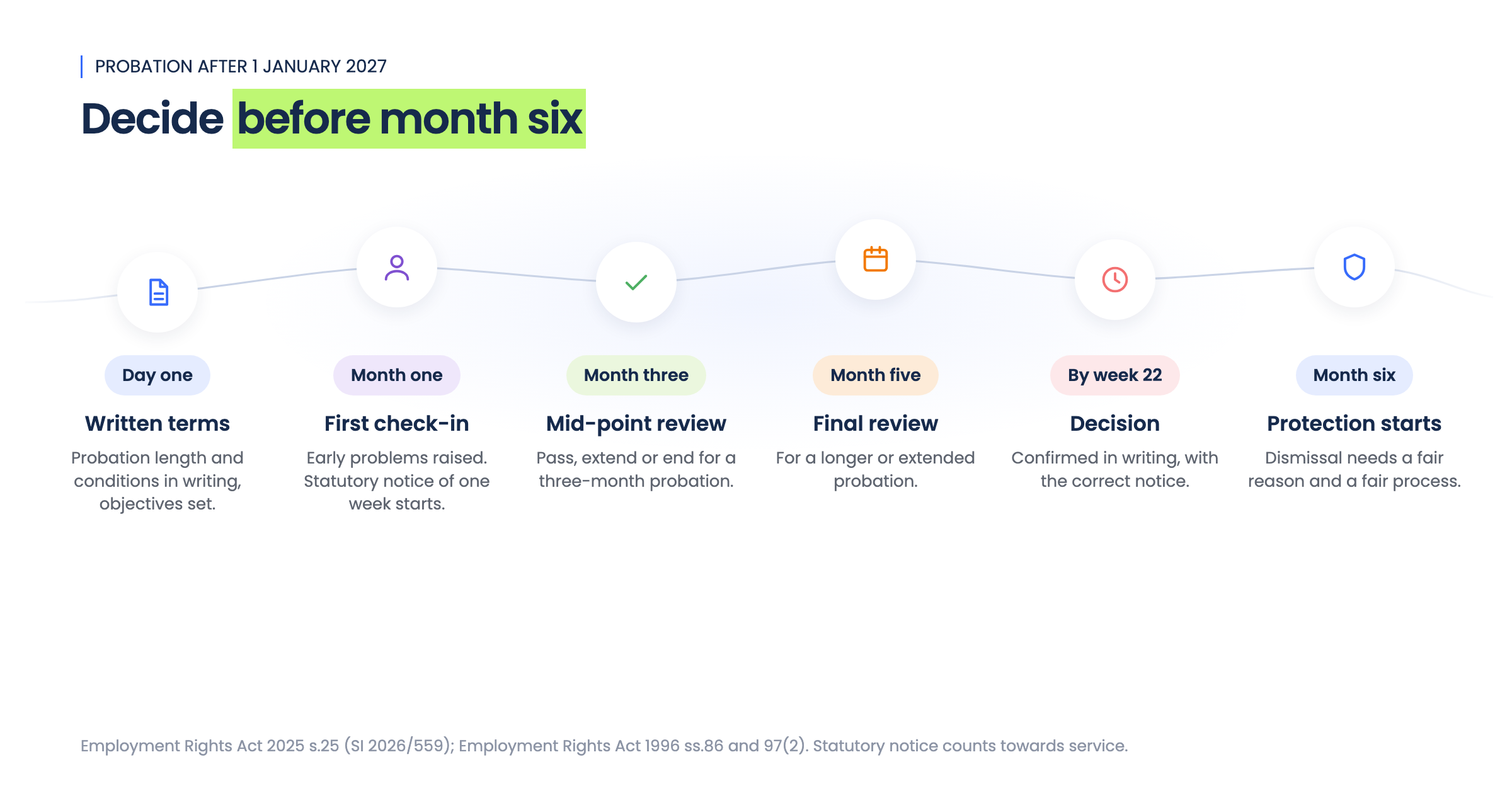
7. A review calendar for the first six months
The aim of the calendar is simple. No employee should reach the end of probation without having been told, more than once and in writing, how they are doing. That is good management in any year. From 2027 it is also the record you will need if the decision is challenged.
| When | What happens | Record |
|---|---|---|
| Day one | Written statement given. Manager sets three to five objectives for probation and explains how they will be judged | Signed terms, written objectives |
| Month one | First check-in. Early problems with training, equipment or fit are raised by either side | Short note sent to the employee |
| Month three | Mid-point review against each objective. For a three-month probation this is the decision: pass, extend or end | Review form, outcome letter |
| Month five | Final review for anyone on a longer or extended probation | Review form |
| By week 22 | Decision made and confirmed in writing: passed, or employment ends with the correct notice | Outcome letter |
| Month six | Ordinary unfair dismissal protection applies |
Put the dates in the calendar on the day the offer is accepted, not when the manager remembers. In a small company the usual failure is not a harsh decision. It is no decision at all, because the review was never held.
8. What to record at each review
A probation review form does not need to be long. It needs to show that the employee knew what was expected, was told where they fell short, and was given help and time to improve. One page with these fields is enough.
- Employee, role, manager, start date and the date probation ends.
- The objectives set on day one, each with a rating and one or two factual examples.
- Attendance and timekeeping, with dates. Our Bradford Factor calculator puts a number on repeated short absences, but check the reason for each absence before relying on it. Absence linked to disability or pregnancy must be handled separately.
- What has gone well.
- What needs to improve, by when, and how it will be measured.
- Support the employer will give: training, shadowing, clearer instructions, equipment.
- The employee's own comments.
- Outcome: on track, concerns raised, extended, passed or ended.
- Date, and both signatures or an email confirming the employee has received it.
Write examples, not adjectives. "Missed the monthly reporting deadline on 3 and 31 October" can be answered and can be improved. "Poor attitude" can do neither, and reads badly in front of a tribunal.
9. Extending probation
Acas guidance on extensions is short and worth following to the letter.
- Extend only if the contract allows it, or the employee agrees.
- Confirm the extension in writing before the original probation ends. Leaving it until afterwards can be a breach of contract, because the employee may already be treated as having passed.
- Say why, for how long, what has to improve and what support will be given.
- Update the written statement within one month of the change.
From January there is a new limit to add: an extension that runs past six months of service gives the employee unfair dismissal protection while it runs. If you extend a three-month probation, end the extension by month five, so that a decision can still be made in time.
10. Ending employment during probation
Acas describes dismissal during probation as a last resort. Where it is the right decision, a short and fair process protects both sides, even though the employee cannot yet claim ordinary unfair dismissal.
- Check the reason. Make sure it is about performance, conduct or suitability, and not connected to pregnancy, family leave, disability, sickness linked to a disability, a request for a statutory right, a health and safety concern, whistleblowing or trade union membership. Those claims need no service at all.
- Check the record. The employee should already have been told about the problem at a review, and given time to improve.
- Invite them to a meeting in writing. Say that the outcome may be the end of their employment, and let them bring a colleague or a trade union representative.
- Hold the meeting and listen. Sometimes the explanation changes the decision: training that was never given, a health condition, a problem with the manager.
- Confirm the outcome in writing. Give the reason, the last day of employment, the notice or payment in lieu, and pay for holiday accrued but not taken. Our holiday entitlement calculator works out the leave owed to a leaver.
- Offer an appeal. It costs little and often ends the matter there.
Give the correct notice. A dismissal with less notice than the contract or statute requires is a breach of contract whatever the length of service, and tribunals can raise an award by up to 25% where an employer has unreasonably failed to follow the Acas Code of Practice on disciplinary and grievance procedures. Acas consulted on a revised Code between July and September 2026 and has not yet said when it will take effect, so check which version is current when you act.
11. After six months
Passing six months does not make dismissal impossible. It means the employer has to be able to show two things: a fair reason, and a fair process.
The law recognises five fair reasons: capability or qualifications, conduct, redundancy, a legal restriction that prevents the employment continuing, and "some other substantial reason". Poor performance is a capability reason. A fair capability process usually means telling the employee clearly what is wrong, setting targets and a reasonable time to meet them, giving support, warning in writing that dismissal is possible, and allowing an appeal.
That takes weeks or months, which is the real cost of missing the probation deadline. It is also worth keeping the scale of the financial risk in proportion. The compensatory award is based on what the employee has actually lost, and in 2023 to 2024 the median unfair dismissal award was £6,746. Removing the cap matters most for senior and highly paid employees, whose losses could exceed the old limit.
From six months an employee can also ask for written reasons for their dismissal, and the employer has 14 days to give them. One group does not need to ask or to wait: an employee dismissed while pregnant, or on maternity or adoption leave, must be given written reasons whatever their length of service (Employment Rights Act 1996, section 92(4)).
12. An employer checklist for December
- List everyone with under two years of service, with the date each reaches six months. Mark those who will already have six months on 1 January 2027.
- Review anyone on that list whose performance or conduct is in doubt, and take advice before the end of December if a dismissal is being considered.
- Check any notice already given: if it ends on or after 1 January 2027, the new rules apply to it.
- Decide your standard probation length for new contracts. Three months, extendable to five, suits most roles.
- Update the contract template: length, conditions, extension, notice, payment in lieu and written confirmation of passing.
- Set review dates at months one, three and five for every new starter, with week 22 as the decision deadline.
- Adopt a one-page probation review form and make it the only way reviews are recorded.
- Brief every line manager: reviews are held on time, concerns are put in writing, and no one is dismissed without HR or the owner checking the reason first.
- Keep review records and letters for at least a year after an employee leaves, to cover the six-month window for tribunal claims and Acas early conciliation.
13. If you also employ people in Türkiye
The six-month line is new in Britain, but a UK company with a team in Türkiye already works with one. The two systems now look more alike at six months and less alike before it.
| Topic | Great Britain from 1 January 2027 | Türkiye |
|---|---|---|
| Probation length | No legal limit; a term of the contract | Two months at most, four under a collective agreement (Labour Act No. 4857, article 15) |
| Ending employment during probation | Contractual or statutory notice applies | Either side can end the contract without notice and without compensation |
| Protection from dismissal | Unfair dismissal after six months, any size of employer | Job security after six months, where the employer has 30 or more employees and the contract is indefinite |
| Remedy | Compensation, with no cap on the compensatory award | Reinstatement within one month, or four to eight months' pay, plus up to four months' idle-time pay |
What this means depends on where you are.
- If you are setting up in Türkiye. Do not copy your UK contract. A three or six-month probation clause is not valid there beyond the two-month limit, so the assessment has to be planned for the first eight weeks. Our guide to setting up a company in Türkiye and hiring covers the first contract and the first payroll.
- If you already have a branch or subsidiary there. Your Turkish managers have been making this decision early for years. Between month two and month six the employee has notice rights but, in a workplace of 30 or more, not yet job security. After month six a dismissal needs a valid reason in writing. Our guide to ending employment in Türkiye explains the process, and employing people in Türkiye sets out the wider rules.
14. How Kolay IK helps
Kolay IK is HR software used by more than 2,600 companies to keep employee records, leave and performance reviews in one place. For probation, that means:
- Performance Review lets you run probation reviews from a template, with each objective, rating and comment recorded against the employee and the date.
- Employee Management keeps the contract, the written statement, review forms and outcome letters in one employee file, with reminders for important dates such as the end of probation.
- Leave Management records absence and holiday from the first day, so attendance at a review is a matter of record.
- HR Analytics shows headcount and turnover, including how many people leave in their first months.
See how it works for your team in a short demo.
Frequently asked questions
Does a probation period have any legal status in the UK?
Not on its own. There is no legal requirement to have one and no statutory limit on its length. It is a term of the contract, and it must be set out in the written statement given on or before the first day, with its conditions and its length.
Can I still have a six-month probation period after 1 January 2027?
Yes. Nothing in the Employment Rights Act 2025 limits the length of probation. The difference is that an employee gains the right to claim ordinary unfair dismissal at six months, so a decision at the very end of a six-month probation comes too late. Hold the final review at month five and decide by about week 22.
Can I dismiss an employee during probation without a process?
An employee with less than six months of service cannot claim ordinary unfair dismissal, but they can still claim discrimination, automatically unfair dismissal and breach of contract from the first day. A short process, with a meeting, a written reason and the correct notice, is the safe approach and is what Acas recommends.
Does the notice period count towards the six months?
Yes. If notice is worked, employment ends when the notice ends. If the employee is dismissed without notice, the statutory minimum notice, one week after a month of service, is normally added when the tribunal counts their service. Treat protection as starting at least a week before the six-month date.
Can I extend probation beyond six months?
You can, if the contract allows it or the employee agrees, and if you confirm it in writing before the original period ends. From 1 January 2027 the employee will have unfair dismissal protection once they pass six months of service, so ending employment after that needs a fair reason and a fair process.
What happens if I do not confirm that probation has been passed?
Unless the contract says otherwise, an employee who carries on working after the end date is normally treated as having passed. Any shorter notice period or other probation terms stop applying. Confirm the outcome in writing every time, whichever way it goes.
Do the new rules apply in Northern Ireland?
No. Unfair dismissal law is devolved. The qualifying period in Northern Ireland is one year and the change on 1 January 2027 does not apply there.
Sources
The law and figures in this guide were checked on 26 November 2026 against: the Employment Rights Act 2025, section 25 and Schedule 3; the Employment Rights Act 2025 (Commencement No. 4 and Transitional and Saving Provisions) Regulations 2026 (SI 2026/559); the Employment Rights Act 1996, sections 1, 86, 92, 97, 98 and 108; the Employment Rights (Increase of Limits) Order 2026 (SI 2026/310); the Trade Union and Labour Relations (Consolidation) Act 1992, section 207A; the Employment Rights (Northern Ireland) Order 1996, article 140; Acas guidance on probation periods (updated 7 October 2026) and on unfair dismissal; the government's economic analysis of the Employment Rights Act 2025; and, for Türkiye, Labour Act No. 4857, articles 15 and 18 to 21.
Official texts and guidance used for this guide:
- Employment Rights Act 2025, section 25 (legislation.gov.uk)
- Employment Rights Act 2025 (Commencement No. 4 and Transitional and Saving Provisions) Regulations 2026, SI 2026/559 (legislation.gov.uk)
- Employment Rights Act 1996, section 97: effective date of termination (legislation.gov.uk)
- Employment Rights Act 1996, section 1: statement of initial employment particulars (legislation.gov.uk)
- Employment Rights Act 1996, section 92: right to written statement of reasons for dismissal (legislation.gov.uk)
- Employment Rights Act 1996, section 98: fairness of dismissal (legislation.gov.uk)
- Probation periods (Acas)
- Extending a probation period (Acas)
- Dismissal during probation (Acas)
- Unfair dismissal (Acas)
- Unfair dismissal rights: guidance for employers (business.gov.uk)
- Unfair dismissal factsheet (GOV.UK)
- Employment Rights Act 2025: economic analysis (GOV.UK)
- Labour Act No. 4857 (mevzuat.gov.tr, in Turkish)
Important: this guide is not legal or payroll advice
This guide gives general information about UK employment law, with a short comparison with Türkiye. It is not legal, tax or payroll advice, and the rules in it can change as regulations and codes of practice are made. Every dismissal turns on its own facts. Before you act, discuss employment law questions with a qualified employment solicitor and payroll questions with your accountant or payroll adviser; for Türkiye, with a Turkish employment lawyer and a certified public accountant (mali müşavir).
If you would like to talk any of this through, you can contact us at any time.