Setting up a company in Türkiye and hiring your first employee

November 24, 2026


Most UK companies come to Türkiye the same way. A product is selling there, a partner is asking for local support, or a team of engineers in Istanbul looks like the right next hire. At some point the question changes from "should we?" to "how do we actually start?", and the answer involves a trade registry, a tax office, a bank, the social security institution and an employment contract, in that order.
This guide takes you from zero to your first employee's first payslip. It covers choosing a legal structure, forming the company, what happens after registration, getting ready to hire, and the first months of payroll. For the employment rules themselves, read our guide to employing people in Türkiye. Every figure is for 2026 and was checked on 24 November 2026.
In this guide
- Choose your structure
- What to prepare in the UK
- Forming the company step by step
- After registration
- Before your first hire
- Hiring your first employee
- The first months: payroll and filings
- From zero to first payslip
- How we help from day one
Key points
- Most UK companies set up a limited company (limited şirket) or a joint-stock company (anonim şirket) in Türkiye. Both can be fully foreign-owned, with no local partner.
- The minimum capital is TRY 50,000 for a limited company and TRY 250,000 for a joint-stock company. A limited company can pay it in within 24 months; a joint-stock company pays at least 25% before registration.
- Registration itself can take a day once the documents are ready. Most of the time goes on apostilled and translated documents from the UK, tax numbers and the bank account.
- Registering the company with the trade registry also registers it with SGK as a workplace, so you do not file a separate workplace registration before your first hire.
- Every employee must be registered with SGK before they start work, and payroll is filed every month by the 26th.
- Get in touch and we will take care of it: company formation through our network of lawyers and certified public accountants, and HR and payroll ready for your first hire, from day one.
1. Choose your structure
Foreign investors in Türkiye are treated the same as local ones under the Foreign Direct Investment Law No. 4875, and a UK company can own 100% of a Turkish company. There are four common ways in. If you are still deciding whether to set up at all, our comparison of an Employer of Record, contractors and your own company covers that choice.
| Structure | What it is | Good for |
|---|---|---|
| Limited company (limited şirket, Ltd. Şti.) | A separate company with 1 to 50 shareholders, who can be people or companies. Minimum capital TRY 50,000. At least one shareholder must hold management and representation rights. | Most small and medium teams. Simpler and cheaper to run. |
| Joint-stock company (anonim şirket, A.Ş.) | A separate company with one or more shareholders and a board of one or more members, who do not need to be Turkish residents or citizens. Minimum capital TRY 250,000, or TRY 500,000 under the registered capital system. | Larger operations, outside investors, a future sale or listing. Shares transfer more easily. |
| Branch (şube) | Part of the UK company, registered in Türkiye, with a representative resident there. No minimum capital, but the UK company stays liable for everything the branch does. | Companies that want to trade in Türkiye without a separate subsidiary. |
| Liaison office (irtibat bürosu) | An office licensed by the Ministry of Industry and Technology that may not carry out any commercial activity. The first licence runs for up to three years. | Market research and representation only. Not a way to sell or invoice. |
For a UK company that wants to employ people and invoice customers in Türkiye, the choice is usually between a limited company and a joint-stock company. Two details often decide it. A limited company always needs at least one shareholder as a manager, which in a wholly owned subsidiary means the UK parent, acting through a named individual. A joint-stock company with capital of five times the legal minimum or more, which commentators read as TRY 1,250,000, must also retain a contracted lawyer under article 35 of the Attorneys Act.
2. What to prepare in the UK
Documents issued in the UK have to be accepted by a Turkish trade registry, so they go through three steps: an apostille in the UK, a sworn translation into Turkish, and notarisation in Türkiye. Start this early, as it is usually the slowest part.
- For a UK company shareholder: a certificate of incorporation or good standing, the articles of association, and a board resolution approving the investment and naming who will sign and act for it in Türkiye.
- For individuals: passports for shareholders, managers and board members, and a power of attorney if someone in Türkiye will sign on their behalf.
- A company name, a business activity and an address in Türkiye. The registered office must be a real address, because the tax office visits it after registration. Some companies start with a serviced or virtual office; check with your accountant that the tax office will accept it.
- An accountant. In practice every Turkish company works with a certified public accountant (mali müşavir), who files tax returns and keeps the books. Choose one before formation, because they normally handle the tax registration too.
3. Forming the company step by step
- Draft the articles of association in MERSİS, the Ministry of Trade's central registry system. The articles set the name, activity, capital, shareholders and managers.
- Get potential tax numbers for foreign shareholders and managers from a Turkish tax office. These are needed before the bank will open the capital account.
- Sign. For a limited company the founders sign the articles before trade registry staff; for a joint-stock company, before registry staff or a notary. A representative with a power of attorney can sign for a foreign shareholder.
- Pay in the capital. Open a capital account at a Turkish bank and block the amount due before registration, which for a joint-stock company is at least 25% of the cash capital. Pay the Competition Authority fee of 0.04% of the capital, which is also due on every later capital increase.
- Register. The trade registry registers the company, certifies the opening of its books and passes the registration to the tax office and to SGK. Invest in Türkiye says registration can be completed the same day; the announcement in the Trade Registry Gazette follows in about ten days.
- Tax office visit. The tax office inspects the registered office (yoklama) to confirm that the company is really there. Your accountant arranges the follow-up: tax certificate, signature circular and access to the tax administration's online systems.
Companies registered from 1 January 2026 keep their share ledger and general assembly book in the Ministry of Trade's electronic system rather than on paper.
4. After registration
- Bank account. Once registered, the company converts or opens its operating account. Turkish banks run know-your-customer checks on the UK parent and its ultimate owners, so have the ownership chart and the apostilled documents to hand.
- Foreign investment forms. A company with foreign capital reports its capital payments through the E-TUYS system of the Ministry of Industry and Technology, and files an annual activity form each May.
- Electronic notifications. Companies receive tax notices electronically and need access to the tax administration's e-notification system from the start. Your accountant will also tell you when e-invoicing becomes compulsory, which for most companies is when gross sales reach TRY 3 million.
- Tax. Corporate tax is 25% in 2026. VAT returns are monthly, provisional corporate tax is quarterly, and the annual corporate tax return is due by the end of April.
- Data protection. Your Turkish company becomes a data controller under the Personal Data Protection Law No. 6698 (KVKK) the moment it holds employee data. Check with a lawyer whether it must register with the data controllers' registry (VERBİS); small companies are often exempt, but the exemptions depend on headcount, balance sheet and the kind of data you process. Sending employee data to the UK parent is a transfer abroad with its own rules.
5. Before your first hire
A UK employer registers with HMRC as an employer before running payroll. In Türkiye the company's registration with the trade registry already counts as its workplace registration with SGK under article 11 of Law No. 5510, and it also replaces separate notices to the employment agency (İŞKUR) and the Ministry of Labour. What you still need before the first person starts:
- Access to SGK's online systems (e-Bildirge), to submit starter notices and monthly data. Your accountant or payroll provider usually sets this up.
- Health and safety cover. Since 31 December 2024 every workplace, including offices with fewer than 50 employees, must appoint an occupational safety specialist and a workplace doctor. Most small employers contract an outside provider (OSGB); appointments are recorded in the ministry's İSG-KATİP system. Employees also receive health and safety training.
- An employment contract in Turkish, with a probation period of up to two months, working time within 45 hours a week and the salary stated as gross or net. Decide gross or net before you make offers; our Türkiye employee cost calculator shows the difference.
- A personnel file for every employee, with the documents Turkish law and SGK expect, kept for the length of employment and afterwards.
- Work permits for any foreign staff, including UK managers who will work in Türkiye. A new company needs at least TRY 500,000 of paid-in capital for a work permit application, and the salary must be at least a set multiple of the minimum wage: five times for senior executives, four for engineers and architects, three for other managers and two for specialists. The general rule of five Turkish employees for each foreign employee applies, with a grace period for a foreign shareholder who manages the company. Board members of a joint-stock company who live abroad and do not work in Türkiye need no permit for stays of up to three months.
6. Hiring your first employee
- Agree the offer as a gross or net monthly salary, at or above the 2026 minimum wage of TRY 33,030 gross (TRY 28,075.50 net).
- Sign the contract and collect the employee's documents for the personnel file.
- Submit the starter notice to SGK before the employee starts work. A workplace notifying SGK for the first time has a short grace period for people who start in its first month, but the safest habit is to submit the notice no later than the day before day one. A late notice costs a fine of one monthly minimum wage per employee.
- Enrol the employee in a private pension if they are under 45 and a Turkish citizen or a Blue Card holder; other foreign nationals, including UK staff, are not enrolled automatically. The employer deducts 3% of the premium base and transfers it; it makes no contribution of its own, and the employee can opt out within two months.
- Plan the first day: health and safety induction, equipment, and the employee's access to payslips and leave requests.
In most sectors in 2026, a gross salary of TRY 100,000 costs the employer TRY 121,750 a month, after the two-point premium reduction for employers that file and pay on time. Severance pay builds up on top, at about one month of gross pay for each year of service.
7. The first months: payroll and filings
Payroll in Türkiye is monthly. For each month, the employer pays salaries, then files one combined return for income tax and social security (MUHSGK) by the 26th of the following month and pays SGK premiums by the end of that month. Payslips go to every employee. Salaries above a set threshold must be paid through a bank.
Three things trip up new companies in the first months:
- The premium reduction depends on a clean record. One late return or payment costs the two-point reduction for the month, and the SGK hiring incentives you might have claimed.
- Incentives cannot be claimed later. A new company often qualifies for SGK hiring incentives. If they are not claimed in the month they apply to, they are lost. See our guide to SGK incentives in Türkiye.
- Everything changes in January. The minimum wage, SGK floor and ceiling and income tax bands are reset every year, and the severance ceiling every January and July.
For the monthly cycle in detail, read our guide to running payroll in Türkiye.
8. From zero to first payslip
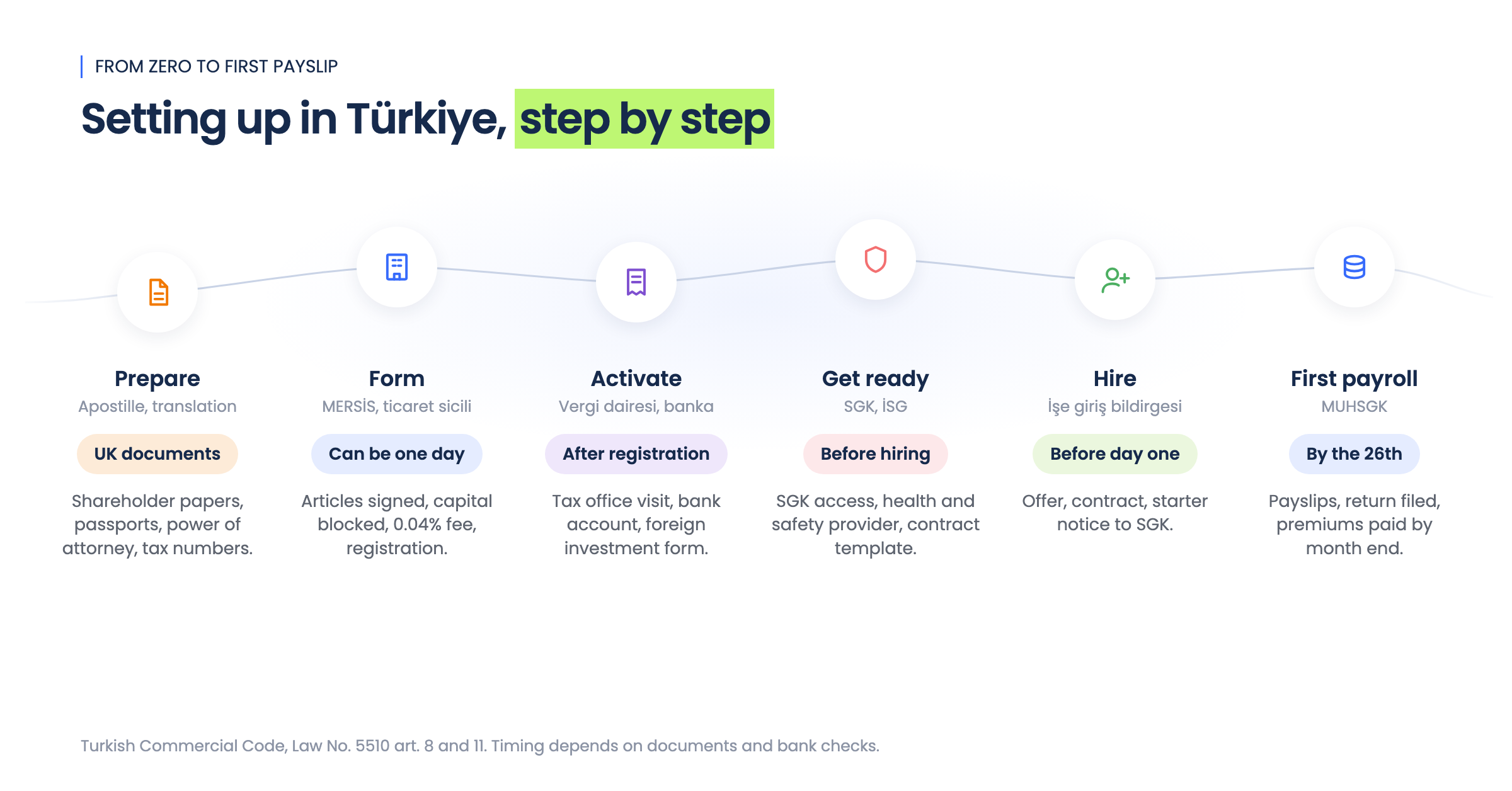
How long it takes depends mostly on how fast the UK documents are ready and how quickly the bank completes its checks. A typical order looks like this:
| Stage | What happens | Who usually does it |
|---|---|---|
| Decide | Structure, capital, managers, registered office | UK board, with a lawyer in Türkiye |
| Prepare | Apostille, sworn translation and notarisation of UK documents; potential tax numbers | UK company secretary, lawyer or accountant |
| Form | MERSİS, signatures, capital account and fee, registration | Lawyer or accountant |
| Activate | Tax office visit, bank account, foreign investment form, e-notifications | Accountant |
| Get ready to hire | SGK access, health and safety provider, contract template, HR and payroll setup | HR, accountant, payroll provider |
| Hire | Offer, contract, starter notice before day one | HR |
| First payroll | Salary, payslips, MUHSGK by the 26th, premiums by month end | Payroll provider or accountant |
9. How we help from day one
Setting up a company in Türkiye? Get in touch and we will take care of it. We handle the formation through our network of qualified lawyers and certified public accountants in Türkiye, and get HR and payroll ready before your first employee starts. You do not have to find a different firm for each step or design local processes from scratch. Contact us and tell us what you are planning.
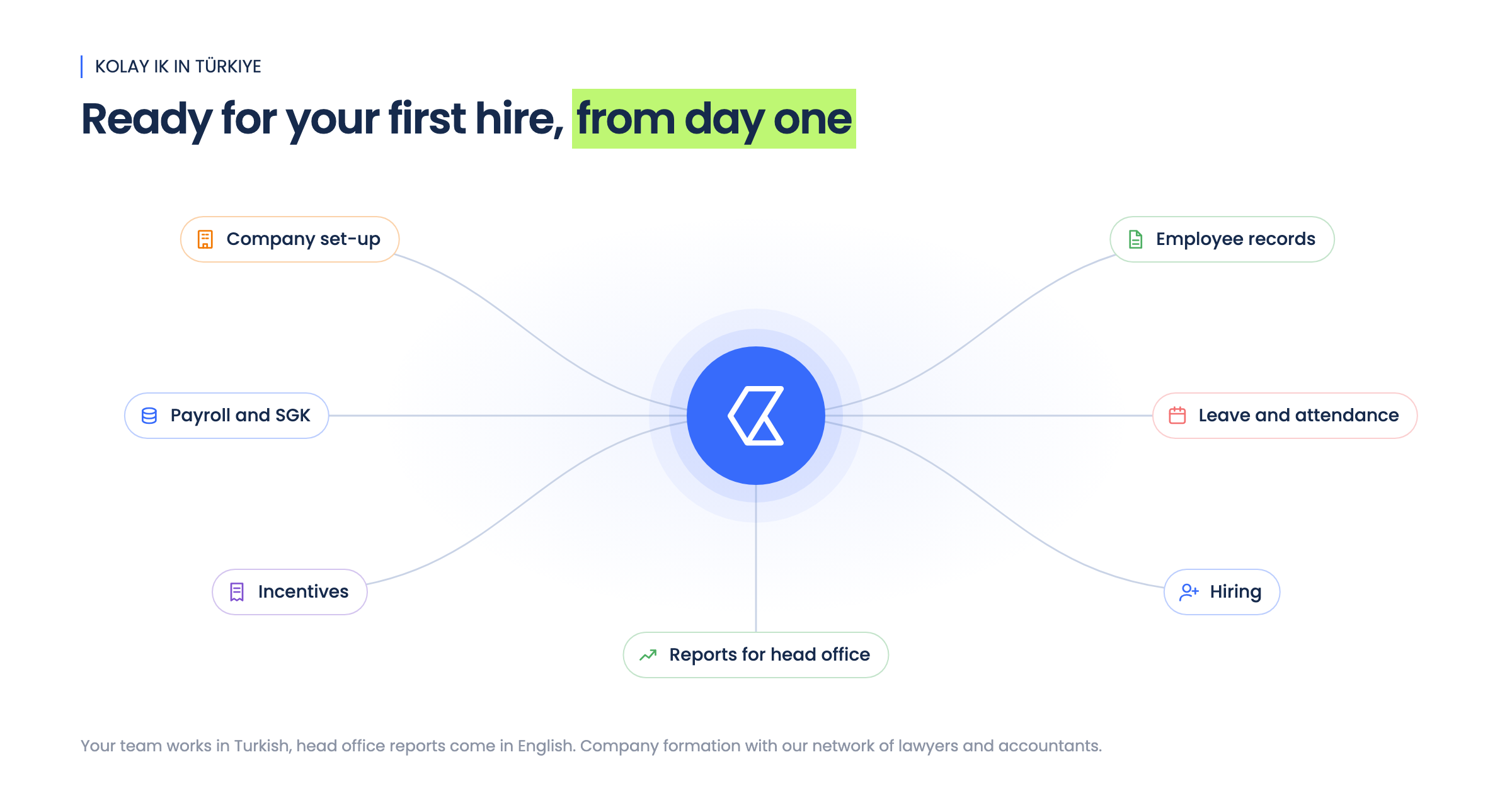
From day one, your team in Türkiye runs on Kolay IK, a Turkish HR and payroll platform used by more than 2,600 companies. Turkish law is built into the product, and HR and finance in the UK see the same records and reports in English.
| What you need in Türkiye | What Kolay IK does |
|---|---|
| Monthly payroll and SGK | Payroll in Türkiye: gross to net, SGK premiums, income tax and stamp duty, starter and leaver notices to SGK, payslips, and SGK incentives calculated inside payroll at no extra fee |
| Payroll you would rather not run yourself | Payroll and Incentive Consultancy: our payroll specialists run payroll and SGK notifications for you |
| Personnel files and employee records | Employee Management: records, documents, history, custom fields and reminders for important dates |
| Leave that follows Turkish law | Leave Management: statutory leave rules ready, balances and accruals calculated, approval flows |
| The 45-hour week and overtime | Time and Attendance and Shift Management, feeding overtime into payroll |
| Hiring your next people | Applicant Tracking: a careers page, one candidate pool, interviews and offers |
| Growing the team fairly | Performance Review and Salary Review |
| Keeping everyone informed | Announcements by email, feed and push notifications |
| Visibility for head office | HR Analytics and reports on headcount, leave, overtime and turnover, plus payroll reports in the format you need |
See how we run payroll in Türkiye for UK companies, work out a salary with the Türkiye employee cost calculator, or book a demo.
Frequently asked questions
Can a UK company own 100% of a company in Türkiye?
Yes. Foreign investors are treated the same as Turkish investors under the Foreign Direct Investment Law No. 4875, and a UK company can be the only shareholder of a Turkish limited or joint-stock company.
What is the minimum capital for a company in Türkiye?
TRY 50,000 for a limited company and TRY 250,000 for a joint-stock company, or TRY 500,000 for a joint-stock company under the registered capital system. If you plan to apply for work permits for foreign staff, a new company needs at least TRY 500,000 of paid-in capital.
How long does it take to set up a company in Türkiye?
The trade registry can register a company in a day once everything is ready. The time goes on apostilling and translating UK documents, getting tax numbers for foreign shareholders and managers, and opening the bank account.
Do I need to register with SGK before hiring?
Registering the company with the trade registry also registers it as a workplace with SGK. You then register each employee with a starter notice before they start work, and file payroll every month by the 26th.
Do I need a local director in Türkiye?
Not for a limited or joint-stock company: managers and board members can live abroad. A branch needs a representative who lives in Türkiye. Anyone who will actually work in Türkiye, including a UK manager, needs a work permit.
Can Kolay IK help me set up a company in Türkiye?
Yes. Contact us and we will take care of it: we handle the formation through our network of lawyers and certified public accountants in Türkiye, and set up HR and payroll so you are ready for your first hire.
Sources
Checked on 24 November 2026 against the Turkish Commercial Code No. 6102 (articles 64, 335, 338, 344, 359, 573, 574, 580, 585 and 623), Presidential Decision No. 7887 on minimum capital and the communiqué of 17 October 2026 (Official Gazette 33403), Competition Authority Communiqué 2017/4, Law No. 5510 (articles 8, 11 and 102), the Attorneys Act No. 1136 article 35, the Ministry of Labour and Social Security's work permit criteria and occupational health and safety guidance, the Ministry of Trade's announcement on electronic company books, and the Invest in Türkiye guide to establishing a business. Tax deadlines, e-invoicing thresholds and data protection registration exemptions were taken from professional firm guides and should be confirmed with your accountant.
Official texts and guidance used for this guide:
- Turkish Commercial Code No. 6102 (official consolidated text, mevzuat.gov.tr)
- Presidential Decision No. 7887 on minimum capital (Official Gazette 32380, resmigazete.gov.tr, PDF in Turkish)
- Communiqué extending the deadline to raise capital to the new minimum amounts (Official Gazette 33403, 17 October 2026, in Turkish)
- Competition Authority notice on the 0.04% share under Communiqué 2017/4 (rekabet.gov.tr, in Turkish)
- Ministry of Trade announcement on electronic company books for companies formed from 1 January 2026 (ticaret.gov.tr, in Turkish)
- Attorneys Act No. 1136 (official consolidated text, mevzuat.gov.tr)
- Work permit evaluation criteria (Ministry of Labour and Social Security, csgb.gov.tr, in Turkish)
- Establishing a business (Invest in Türkiye, invest.gov.tr)
- Get your document legalised (GOV.UK)
Important: this guide is not legal, tax or payroll advice
This guide gives general information about setting up a company and employing people in Türkiye. It is not legal, tax or payroll advice, and the rules and figures in it change often. Before you act, discuss company and employment law with a qualified lawyer, and tax, payroll and social security with a certified public accountant (mali müşavir), who can look at your own circumstances.
If you would like to talk any of this through, you can contact us at any time.