What an employee in Türkiye really costs: the 2026 guide for UK employers

November 25, 2026


Ask what an employee in Türkiye costs and most answers stop at two numbers: the gross salary and the employer's social security premium. Our Türkiye employee cost calculator gives you those in seconds. On a gross salary of TRY 100,000 a month, an employer in most sectors pays TRY 121,750 in 2026.
That is the cost on the payslip. It is not the cost on the budget. Turkish employment law creates liabilities that build up quietly every month and only turn into cash when someone leaves, and the rules that set pay and premiums reset every January and, for severance, every July. A UK finance team that budgets on the payslip figure alone usually finds the gap at the first resignation, the first audit or the first January. This guide covers what the calculator leaves out, in the order a budget meets it. Every figure is for 2026 and was checked on 25 November 2026.
In this guide
- What the calculator shows, and what it does not
- Severance pay: the liability that grows every month
- Leave, notice and dismissal: the other costs that grow with service
- Benefits your offer will need
- Health and safety, payroll and advice
- The calendar: January and July
- Budgeting in pounds
- What you can claim back
- A yearly budget, worked through
- How this compares with the UK
Key points
- The calculator shows gross pay plus employer SGK: 121.75% of gross in most sectors in 2026. A realistic yearly budget is closer to 128% to 135% of gross pay, before any one off costs.
- Severance pay (kıdem tazminatı) builds up at 30 days of gross pay for every year of service, capped at TRY 73,729.87 a year from 1 July 2026. Nothing is paid into a fund, so the whole amount falls due in cash when the employee leaves.
- Unused annual leave is paid out on leaving at the final salary, and notice is two to eight weeks. Both grow with service and with every pay rise.
- Benefits such as meal allowances and private health insurance are common, and regular benefits also raise the severance base.
- Every January the minimum wage, the SGK floor and ceiling and the income tax bands change, and many employers raise pay at the same time. A net salary contract costs around 10% more over the year than the same pay agreed in gross.
- Contracts between Turkish residents are generally in Turkish lira, so a budget set in pounds carries currency risk. Incentives can claw some of the cost back.
1. What the calculator shows, and what it does not
The calculator answers the monthly question: for a given gross or net salary, what does the employer pay to the employee, to SGK (Sosyal Güvenlik Kurumu, the social security institution) and to the tax office? In 2026 the employer share of SGK premiums is 23.75%, reduced to 21.75% in most sectors and 18.75% in manufacturing for employers that file and pay on time and owe SGK nothing. Premiums are charged on pay between TRY 33,030 and TRY 297,270 a month. There is no separate employer payroll tax and no compulsory employer pension contribution. Our guide to social security in Türkiye explains each part of the premium.
The calculator also shows how much severance to set aside each month. What it cannot show are the costs that depend on your company rather than on one salary: how long people stay, what benefits you offer, how you account for liabilities, how you pay for health and safety and advice, and what the lira does against the pound. Those are the subject of this guide.
2. Severance pay: the liability that grows every month
Severance pay is the cost UK employers most often leave out, because the UK has nothing quite like it outside redundancy. In Türkiye an employee with at least one year of service is owed severance on almost every termination by the employer, on retirement, on some resignations for just cause and, for women, on resigning within a year of marriage. It is also paid to the family if the employee dies.
The amount is 30 days of gross pay for every year of service, with part years counted pro rata. Two details make it larger than a UK manager expects:
- The base is wider than basic salary. It is the employee's gross pay including regular benefits such as meal and travel allowances.
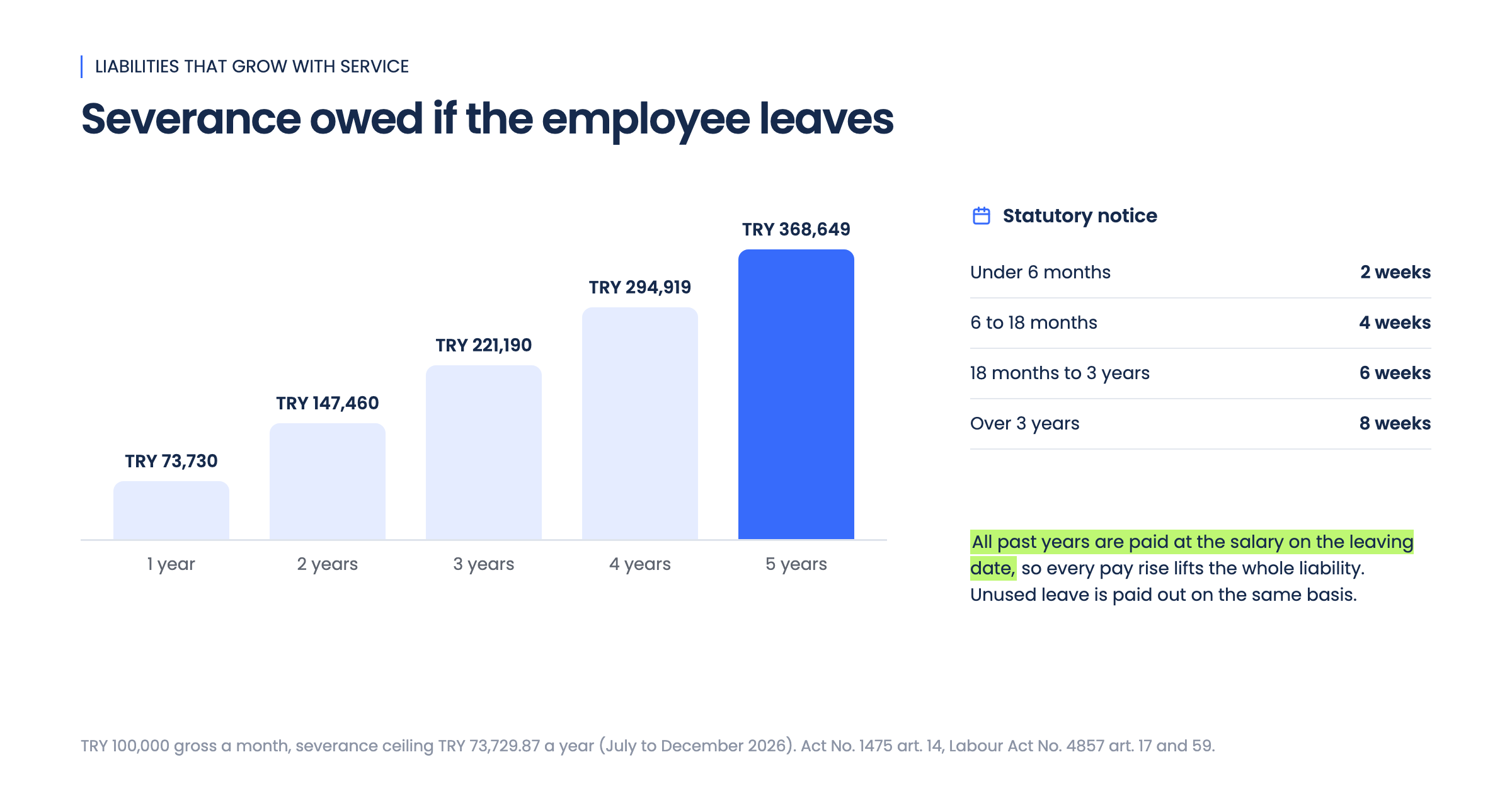
- Each year is capped, but the cap rises. The ceiling is TRY 73,729.87 for each year of service for terminations between 1 July and 31 December 2026, and was TRY 64,948.77 in the first half of the year. It moves with civil service pay every January and July, and the whole service is paid at the salary and ceiling on the leaving date, not at the rates of the years in which it was earned.
That second point is what turns severance into a budget problem. An employee who joined three years ago on a lower salary is owed three years at today's salary, so the liability grows with every pay rise, not only with every year served. Nothing is set aside by law: Türkiye has discussed a severance fund for years, but in 2026 there is none, and the employer pays the whole amount from its own cash when the employee leaves.
A simple rule for a budget is to accrue one month of gross pay a year for each employee, up to the ceiling. For a TRY 100,000 salary that is TRY 73,729.87 a year at the July 2026 ceiling. Our guide to ending employment in Türkiye covers when severance is owed and how it is taxed.
How it shows in the accounts
For a UK group, severance in Türkiye is a defined benefit obligation, not a cash item. Under IFRS (IAS 19), and in a UK parent reporting under FRS 102, it is measured with actuarial assumptions such as salary growth, staff turnover and a discount rate, and the subsidiary's Turkish financial statements under TFRS follow the same approach (TMS 19). Most groups use an actuary for the year end figure.
Tax works differently. The Turkish tax administration's view is that severance is deductible for corporate tax only when it is actually paid, although some court decisions have accepted a deduction on accrual. So the provision in the accounts and the deduction in the tax return usually differ, and that difference belongs in your deferred tax calculation. Your mali müşavir (the Turkish equivalent of a chartered accountant) and auditor will settle the treatment for your entity.
3. Leave, notice and dismissal: the other costs that grow with service
Unused annual leave. Annual leave is 14, 20 or 26 working days a year depending on service, and it cannot be paid out while employment continues. When the contract ends for any reason, all untaken leave is paid at the gross salary on the leaving date. The claim can be made for five years after the end of employment, and the employer has to prove leave was taken, usually with a leave record signed by the employee. Leave that piles up for years and is paid at the final salary can become a large sum, so track balances and encourage people to take their leave.
Notice. Statutory notice is two weeks for less than six months of service, four weeks up to eighteen months, six weeks up to three years and eight weeks after that. During notice the employer must give at least two hours a day, paid, for the employee to look for a new job. An employer can pay in lieu of notice instead, and many do, so notice is a cash cost on most terminations.
Unfair dismissal. In workplaces with 30 or more employees, an employee with six months of service can challenge a dismissal without a valid reason. If the court agrees, the employer pays up to four months' pay for the idle period and either takes the employee back or pays four to eight months' pay on top. This is not a monthly cost, but it is a risk worth pricing into any restructuring.
4. Benefits your offer will need
Few salaried roles in Türkiye are offered on salary alone. The common additions are:
- Meal allowance. Usually paid on a meal card. Up to TRY 300 a day worked is free of SGK premiums where no meal is provided at the workplace (from 17 April 2026), and a similar daily amount on a meal card is free of income tax. For 22 working days a month that is TRY 79,200 a year for each employee.
- Transport. A travel card, a shuttle or a transport allowance, with its own exemption limits.
- Private health insurance. Common in offices and expected in competitive roles. Employer payments into the employee's own private health insurance and private pension are free of SGK premiums up to 30% of the minimum wage a month in total.
- Bonuses. A bonus counts in full for SGK in the month it is paid, with any excess over the ceiling carried into the next two months, and it is taxed at the employee's marginal rate that month.
Remember the link to severance: benefits paid regularly, such as meal and travel allowances, are added to the severance base. A benefit is never only its own cost.
5. Health and safety, payroll and advice
Health and safety. Under the Occupational Health and Safety Law No. 6331 every employer must carry out a risk assessment and train its staff, and employers are required to have an occupational safety specialist and a workplace doctor, usually through an accredited provider called an OSGB, paid as a monthly fee per employee. For low risk workplaces with fewer than 50 employees the start of that requirement was postponed several times, and the Constitutional Court annulled the last postponement in a ruling published in December 2025, so ask your adviser where a small office stands today. New starters in many roles also need a pre employment health check.
Payroll and advice. Payroll is filed to the state every month, and most employers in Türkiye use payroll software and a mali müşavir, who also keeps the books and files the company's tax returns. Add an employment lawyer for contracts and terminations. Our guide to payroll in Türkiye sets out what each of them does.
Recruitment and set up. A first hire also brings recruitment fees, equipment, and, for a non Turkish employee, a work permit. If you have no entity yet, the costs of setting one up come first. See our guide to setting up a company in Türkiye.
6. The calendar: January and July
A Turkish employment budget has two dates on it every year.
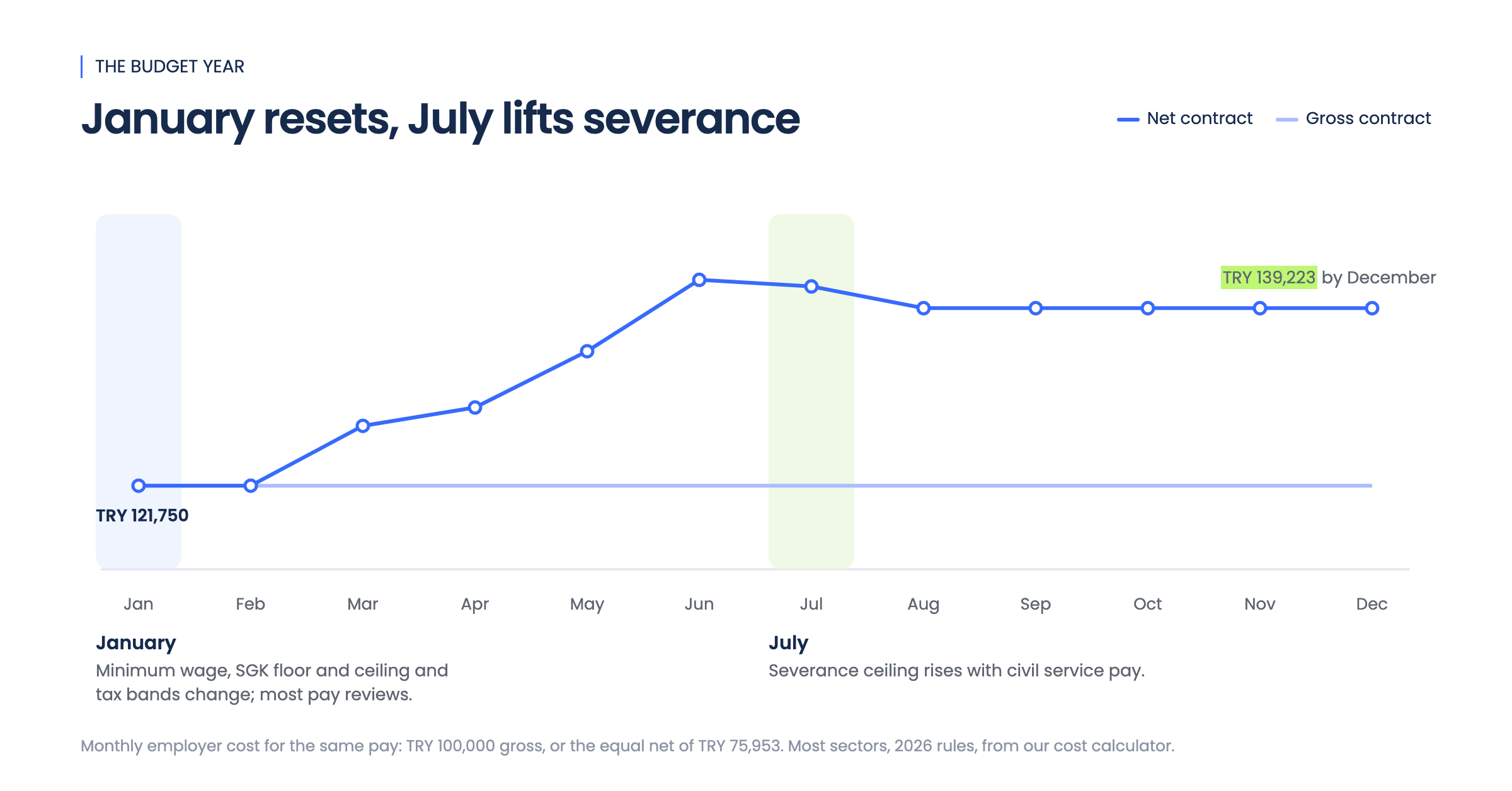
- January. The minimum wage is usually set in late December for the whole of the next year. The SGK floor and ceiling follow it, the income tax bands change, and many employers review all salaries at the same time because of inflation. The 2026 minimum wage of TRY 33,030 was 27% higher than in 2025. Budget for a pay review in January, not at each work anniversary as in the UK.
- July. The severance ceiling rises again with civil service pay, which raises the liability for every employee whose pay is above it. In some years the minimum wage has also risen in July; in 2026 it did not.
The month also matters within the year. Income tax in Türkiye is charged on cumulative pay, so take home pay on a gross salary falls as the year goes on. If your contract fixes the net salary, the employer absorbs that tax instead, and the monthly cost climbs. On a net salary equal to TRY 100,000 gross, the monthly cost rises from TRY 121,750 in January to about TRY 139,223 by December, around 10% more over the year. Net contracts are common in Türkiye, so decide which you use before the first offer, and budget for the December cost, not the January one.
7. Budgeting in pounds
Employment contracts between residents of Türkiye generally cannot be set in or indexed to a foreign currency. There are exceptions, for example where the employee is not a Turkish citizen or where the employer is a branch or liaison office of a non resident company, but for most hires through a Turkish company pay is set and paid in Turkish lira.
That means the cost in pounds moves twice: once with inflation and the January pay review, and again with the exchange rate. The lira has lost value against the pound over many years, which has often softened the cost of January rises in sterling, but it does not move in step with pay, and you cannot count on it. Three habits help:
- Build the budget in lira first, with the January review and the July severance ceiling in it, and convert to pounds afterwards.
- Agree with your board what exchange rate the budget uses, and review it quarterly rather than when the payroll lands.
- Keep the severance liability in lira in your reporting, so a currency move does not hide a growing obligation.
8. What you can claim back
Some of the cost comes back through SGK, as long as returns are filed and paid on time:
- The premium reduction of 2 points in most sectors and 5 points in manufacturing is already in the calculator's figures.
- The minimum wage support of TRY 42.33 a day, about TRY 1,270 a month, is offset against premiums for eligible employees, within a limit based on your 2025 payroll at low daily earnings.
- Hiring incentives such as 6111 can cover the whole employer share for some new hires, for example young people and women who were not in registered employment before.
Which of these you can use depends on your headcount and history, so the calculator leaves them out. An incentive not claimed in the month cannot be claimed later. Our guide to SGK incentives in Türkiye lists the conditions for each one.
9. A yearly budget, worked through
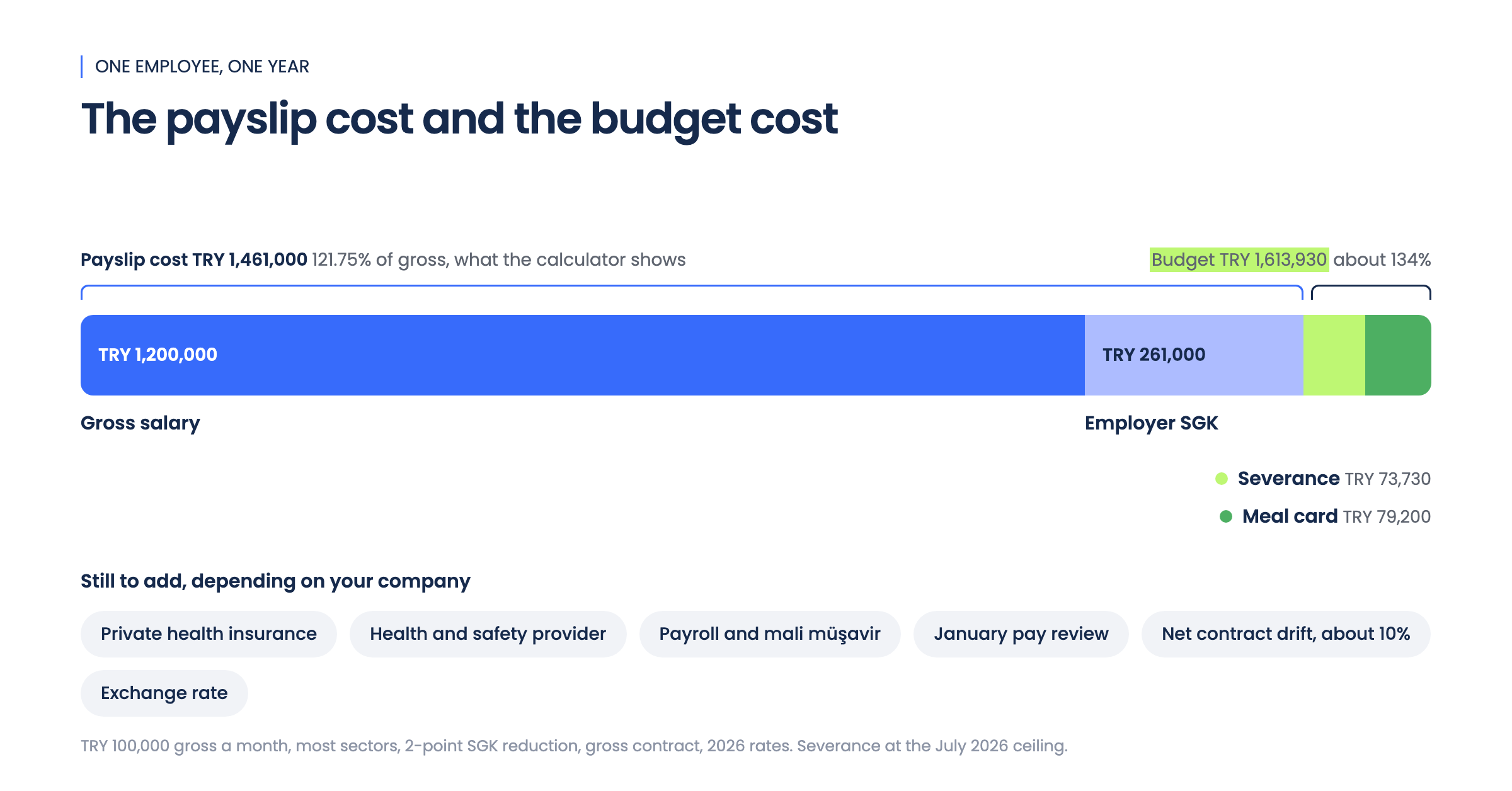
One employee on TRY 100,000 gross a month, in most sectors, with the 2-point SGK reduction, a gross salary contract and a meal card. Figures are for one year at 2026 rates.
| Item | Yearly amount | Where it comes from |
|---|---|---|
| Gross salary | TRY 1,200,000.00 | TRY 100,000 x 12 |
| Employer SGK at 21.75% | TRY 261,000.00 | TRY 21,750 x 12, as in the calculator |
| Payslip cost | TRY 1,461,000.00 | 121.75% of gross |
| Severance accrual | TRY 73,729.87 | One year of service, at the July 2026 ceiling |
| Meal card | TRY 79,200.00 | TRY 300 x 22 days x 12 |
| Budget cost | TRY 1,613,929.87 | about 134% of gross |
On top of that come the items that depend on your company: private health insurance, the health and safety provider, payroll and advice fees, equipment, and the January pay review. If the same pay is agreed as a net salary, add around 10% to the salary and SGK lines. In the other direction, incentives can reduce the SGK line.
For a quick check of the payslip figures for any salary, use the calculator, then add the items in this table.
10. How this compares with the UK
A UK employer pays 15% National Insurance on pay above £5,000 a year and at least 3% of qualifying earnings into a workplace pension, and holiday pay is a running cost rather than a payout on leaving. The Turkish employer share of social security is higher, at 21.75% in most sectors, but it covers pensions and health care with no employer pension contribution on top. The real differences are elsewhere: severance that builds on every salary from the first year, leave that is paid out on leaving at the final salary, a cost that resets every January and a salary paid in a currency that is not your reporting currency.
How Kolay IK helps
Kolay IK runs HR and payroll for more than 2,600 companies in Türkiye. It calculates gross to net, SGK premiums and the incentives you are entitled to every month, at no extra fee for incentives. It keeps leave balances, service dates and salary history in one place, so severance, notice and unused leave can be calculated for any employee on any date, and the liability for the whole team can be reported at month end. If you are planning a team in Türkiye, talk to us before you make your first offer.
Frequently asked questions
How much does an employee really cost in Türkiye?
On the payslip, gross pay plus 21.75% employer SGK in most sectors in 2026, so a TRY 100,000 gross salary costs TRY 121,750 a month. With severance accrual and a meal card, a realistic budget is around 134% of gross, before health insurance, health and safety and advice fees.
Do I need to set money aside for severance pay in Türkiye?
The law does not require a fund, but the liability is real and is paid in cash on leaving. Most employers accrue about one month of gross pay a year for each employee, up to the ceiling of TRY 73,729.87 a year from 1 July 2026, and a UK group measures it actuarially under IAS 19 or FRS 102.
Can I pay employees in Türkiye in pounds?
Generally not when both parties are resident in Türkiye. Exceptions exist, for example for employees who are not Turkish citizens and for branches and liaison offices of non resident companies. Check with a lawyer before you agree a salary in a foreign currency.
When do salaries go up in Türkiye?
Most employers review pay in January, when the minimum wage, the SGK floor and ceiling and the tax bands change. The severance ceiling also rises every July.
Sources
Rules and figures were checked on 25 November 2026 against the Labour Act No. 4857 (articles 17, 18 to 21, 27, 53 and 59 and additional article 3), Act No. 1475 article 14 on severance pay, the Social Insurance and General Health Insurance Law No. 5510 (articles 80 and 81 and provisional article 112), the Occupational Health and Safety Law No. 6331, the 2026 minimum wage decision, the severance ceiling announced for July to December 2026, SGK guidance on meal allowances from 17 April 2026 and the Foreign Currency Communiqué on Decree No. 32. The UK position was checked against GOV.UK.
Official texts and guidance used for this guide:
- Labour Act No. 4857 (official consolidated text, mevzuat.gov.tr)
- Act No. 1475, article 14 on severance pay (official consolidated text, mevzuat.gov.tr)
- Social Insurance and General Health Insurance Law No. 5510 (official consolidated text, mevzuat.gov.tr)
- Occupational Health and Safety Law No. 6331 (official consolidated text, mevzuat.gov.tr)
- 2026 minimum wage announcement (Ministry of Labour and Social Security, csgb.gov.tr, in Turkish)
- Rates and thresholds for employers 2026 to 2027 (GOV.UK)
- Workplace pensions: what you, your employer and the government pay (GOV.UK)
- Holiday entitlement (GOV.UK)
Important: this guide is not legal or payroll advice
This guide gives general information about employment costs, employment law and payroll in Türkiye. It is not legal, tax, accounting or payroll advice, and the rules and figures in it change often. Before you act, discuss employment law questions with a qualified employment lawyer and payroll, tax and accounting questions with a certified public accountant (mali müşavir), who can look at your own circumstances.
If you would like to talk any of this through, you can contact us at any time.