Running payroll in Türkiye: laws and duties

November 21, 2026


A UK company with a team in Türkiye usually meets Turkish payroll in one of two ways. Either a local accountant has been running it for years and head office receives a spreadsheet once a month, or the first employee is about to start and someone in London has been asked to "sort out payroll over there". In both cases the same questions follow. Which laws apply? What exactly does the person running payroll have to do each month? And how much of it should be left to software, or to an adviser?
This guide answers those questions for UK HR and finance teams. It sets out the laws that decide a Turkish payslip, the monthly duties of whoever runs payroll, why most employers use dedicated payroll software, when an adviser earns their fee, and what Kolay IK does for you, including the employer incentives it calculates inside payroll. For the wider picture, start with our guide to employing people in Türkiye. Every figure is for 2026 and was checked on 21 November 2026.
Key points
- A Turkish payslip is shaped by nine laws, led by the Labour Act, the Social Security Law (No. 5510) and the Income Tax Act (No. 193).
- Payroll runs on a fixed monthly cycle: SGK registration before an employee starts, a combined tax and social security return by the 26th of the following month, and premiums paid by the end of that month.
- The obligations sit with the employer, whoever does the work. Late filings bring administrative fines and can cost the employer its premium reduction and other incentives.
- Income tax is cumulative and the main parameters change every January, and some every July, which is why most employers use payroll software built for Türkiye.
- Incentives can cut employer premiums substantially, but an incentive that is not claimed in the month it applies cannot be claimed later.
- Kolay IK calculates the SGK incentives you are entitled to, employee by employee and law by law, inside the payroll application at no extra fee.
The laws you need to know
In the UK most of what payroll needs comes from a few sources: PAYE and National Insurance rules administered by HMRC, the National Minimum Wage, statutory payments and auto-enrolment. Türkiye spreads the same ground across more statutes, and each one adds something to the monthly calculation.
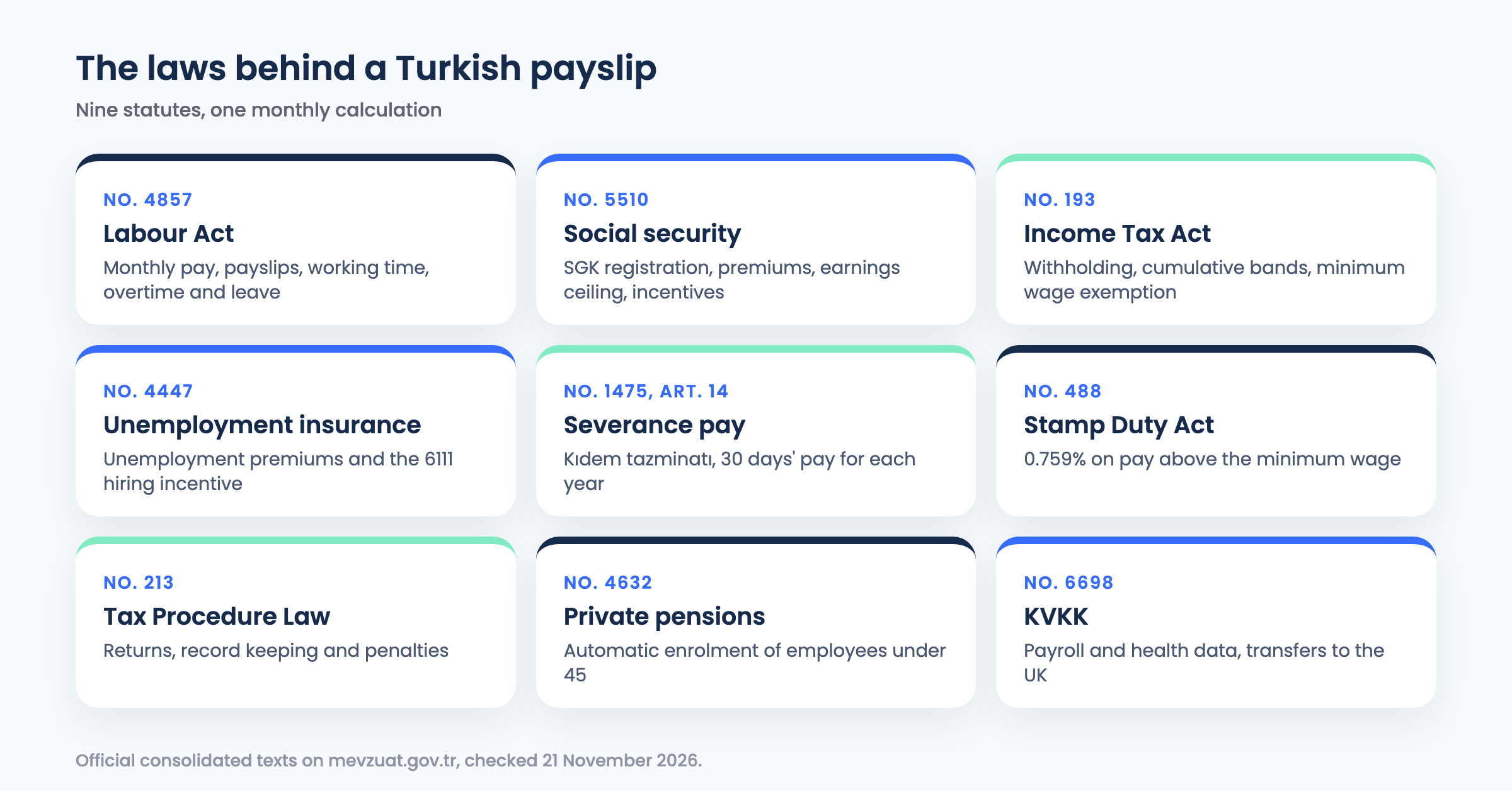
| Law | What it decides for payroll | Closest UK reference |
|---|---|---|
| Labour Act No. 4857 (İş Kanunu) | Wages paid at least monthly, payslips, working time and overtime premiums, annual leave, notice | Employment Rights Act 1996, Working Time Regulations 1998 |
| Act No. 1475, article 14 | Severance pay (kıdem tazminatı), which the 2003 Labour Act left in force | Statutory redundancy pay |
| Social Insurance and General Health Insurance Law No. 5510 | SGK registration, premium rates, the earnings floor and ceiling, monthly reporting, most incentives | National Insurance |
| Unemployment Insurance Law No. 4447 | Unemployment insurance premiums, unemployment benefit and hiring incentives such as 6111 | No direct equivalent |
| Income Tax Act No. 193 | What counts as wages, withholding by the employer, the progressive tax bands, the minimum wage exemption | PAYE |
| Stamp Duty Act No. 488 | Stamp duty of 0.759% on wages above the minimum wage | None |
| Tax Procedure Law No. 213 | Tax returns, record keeping and tax penalties | HMRC filing and penalty rules |
| Private Pension Law No. 4632 | Automatic enrolment of employees under 45 who are Turkish citizens (or Blue Card holders) into a private pension, with deductions from pay | Workplace pension auto-enrolment |
| Personal Data Protection Law No. 6698 (KVKK) | How payroll data, including health data from sick notes, is processed and transferred | UK GDPR and the Data Protection Act 2018 |
Four rules from these laws catch UK teams most often.
- Wages must be paid at least once a month, and in full when employment ends (Labour Act, article 32). An employee whose wages are unpaid 20 days after payday, other than through force majeure, may refuse to work, and late wages carry interest at the highest bank deposit rate (article 34). Wage claims can be brought for five years.
- An employer with three or more employees in Türkiye must pay wages through a bank (article 32 and the bank payment regulation, since 1 July 2025), and a payslip is required with each payment (article 37).
- Income tax is cumulative over the calendar year. There is no tax code to spread the bands evenly, so take-home pay on a fixed gross salary falls as the year goes on and resets in January.
- Every employee benefits from the minimum wage exemption, whatever they earn. For stamp duty, the part of pay that equals the minimum wage is exempt. For income tax, the employee's tax is calculated in full and then reduced by the tax a minimum wage earner would pay that month, so a higher earner does not save tax at their own top rate.
The 2026 figures behind these rules are set out in our guide to employing people in Türkiye: the minimum wage is TRY 33,030.00 gross a month, employees pay 15% in social security and unemployment premiums, and employers pay 23.75% before reductions, on earnings up to TRY 297,270 a month. Our guide to social security in Türkiye explains how SGK premiums and the premium base work.
What the person running payroll is responsible for
In law the duties belong to the employer. Whether payroll is run by your own team, a local accountant or a provider, the employer is the one that pays the fines, loses the incentives and defends the claims. It helps to know what the job involves before you decide who does it.
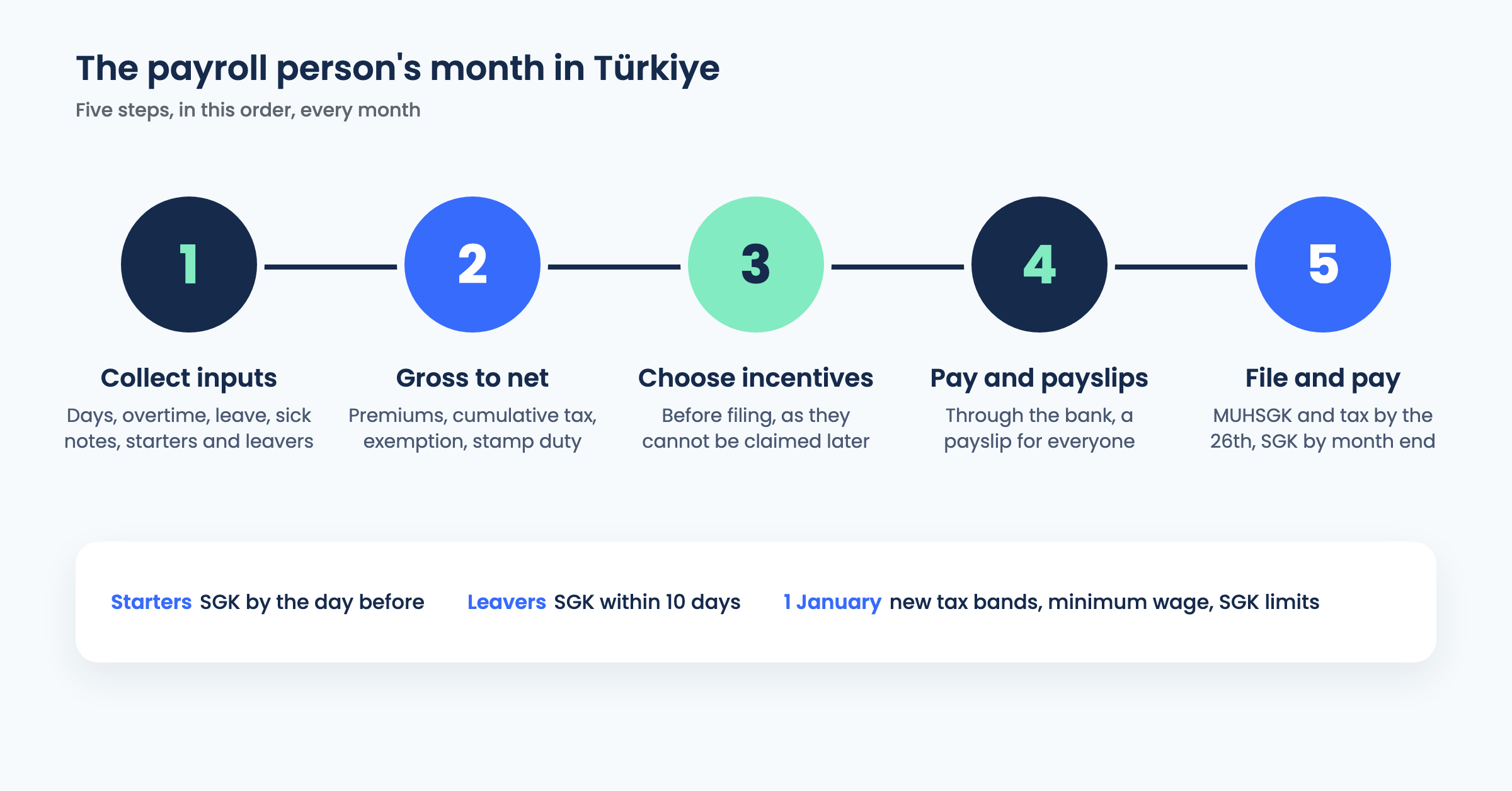
Every month
- Collect the inputs. Days worked, overtime, unpaid leave, sick days, new starters and leavers, bonuses, allowances and any deductions such as private pension contributions and court enforcement orders (icra). Most errors start here, not in the calculation.
- Calculate gross to net. Social security and unemployment premiums up to the earnings ceiling, income tax on cumulative earnings, the minimum wage exemption and stamp duty.
- Choose the incentives. Decide which incentive applies to each employee before the return is filed. The choice cannot be made later.
- Pay and issue payslips. Pay through the bank and give each employee a payslip.
- File and pay the state. File the combined return for income tax and social security (Muhtasar ve Prim Hizmet Beyannamesi, MUHSGK) and pay the tax by the 26th of the following month, then pay the SGK premiums by the end of that month.
Whenever something changes
- New starters are registered with SGK no later than the day before they start work. Construction, fishing and agriculture can report on the day work starts, and a workplace registering with SGK for the first time has one month for people who start in that first month.
- Leavers are reported to SGK within ten days, and the final payroll includes notice pay, severance and unused annual leave where they are owed. Each is taxed differently, as our guide to ending employment in Türkiye explains.
- Sick notes issued by doctors reach the employer through SGK's system and have to be confirmed, because SGK pays a benefit from the third day and the employer adjusts pay to match. For employees on a fixed monthly salary, only the SGK benefit can be offset, so the safer course is to pay the first two days in full.
- New parameters take effect on 1 January, when the minimum wage, the SGK floor and ceiling and the tax bands change, and the severance ceiling changes again on 1 July.
All year round
- Keep records that can be produced to a labour inspector or an SGK auditor: personnel files, time records, signed payslips or proof of delivery, and bank payment lists.
- Protect the data. Payroll holds identity numbers, bank details and health information, and KVKK treats health data as a special category. Access has to be limited, and a transfer to a UK head office needs a lawful transfer mechanism.
- Report to the business. Head office needs cost, headcount and accrual figures in a form it can use, including the severance liability that builds up every year. Our guide to what an employee in Türkiye really costs shows how to budget for it.
For comparison, a UK payroll team files a Full Payment Submission to HMRC on or before each payday, operates tax codes that HMRC issues, and pays statutory sick, maternity and paternity pay itself. In Türkiye the reporting is monthly and in arrears, the tax calculation is the employer's own, and most statutory benefits for absence are paid by SGK rather than through payroll.
Why use payroll software
Small Turkish payrolls are still run on spreadsheets, and they work until something changes. Turkish payroll changes more often than UK payroll, and each change has to be applied on the right date to the right people.
- The parameters move. In 2026 alone the employer's pension premium, the premium reduction and the earnings ceiling changed, and the minimum wage support was renewed for 2026 with a new amount. Software maintained for Türkiye applies those changes for you, from the date they take effect.
- The calculation is cumulative. Every month depends on the months before it. A correction in March changes the tax in every later month, which a spreadsheet does not track on its own.
- The inputs live elsewhere. Leave, overtime and attendance are recorded in HR and time systems. Typing them into payroll each month is where most mistakes come from.
- Incentives need checking every month. One employee can qualify under several laws, and the best choice can change from month to month.
- Head office needs reports, not files. Software produces the same reports every month, broken down by workplace, department or cost centre, instead of a spreadsheet built by hand.
- An audit trail. When an inspector or a former employee asks how a figure was reached, software can show what changed and when.
Why use an adviser
Software calculates payroll. It does not decide how your company should be set up, or how to handle a situation the law treats in more than one way. That is where an adviser comes in, and in Türkiye there are two kinds worth knowing.
- A certified public accountant (mali müşavir) handles tax and social security questions and, in practice, files the monthly return for most employers. They are the right person for questions about tax exemptions, incentive eligibility, the treatment of benefits in kind and anything that touches the company's accounts.
- An employment lawyer handles contracts, dismissals, disputes and mediation. Payroll records are often the main evidence in those disputes, so the two roles work closely together.
An adviser earns their fee in the decisions that are expensive to get wrong: whether to agree salaries in gross or net, whether a salary can be paid in a foreign currency, how to structure bonuses and allowances, how to respond to an SGK inspection, and how to settle an employee's claims at the end of employment. A UK company also gains someone who can explain a Turkish rule in plain terms to head office.
Incentives: money many employers leave on the table
Türkiye uses social security incentives to encourage employment, and they can reduce the employer's premiums substantially. They are applied in the monthly return, so they are a payroll task rather than a grant application. The table shows the incentives most employers meet in 2026. For the full list, with the law, rate and conditions of each one, see our guide to SGK incentives in Türkiye.
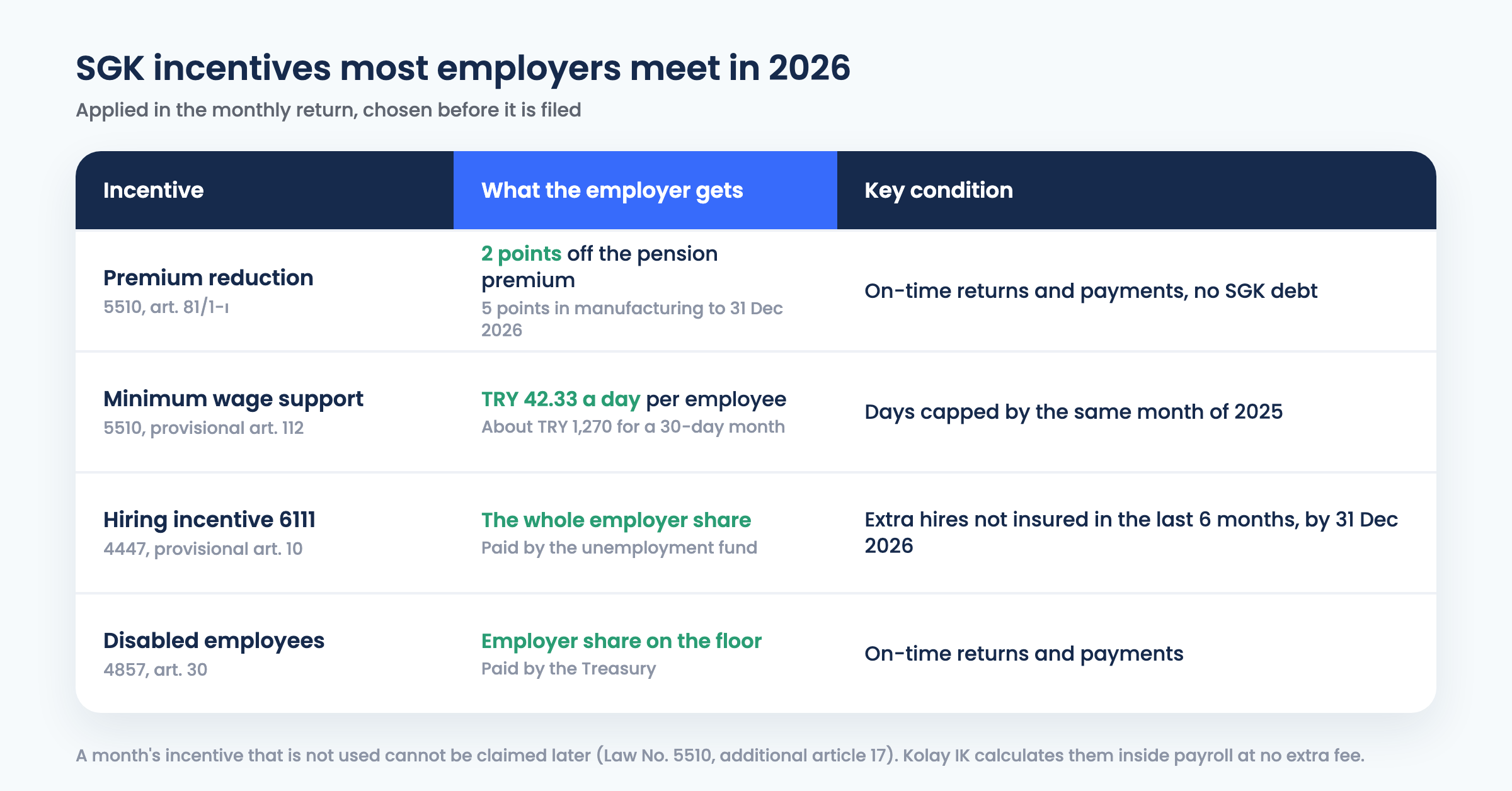
| Incentive | What it gives the employer | Main conditions |
|---|---|---|
| Premium reduction (Law No. 5510, article 81/1-ı and provisional article 108) | Two percentage points off the employer's pension premium, five points in manufacturing until 31 December 2026 | Returns filed and premiums paid on time, and no overdue SGK debt |
| Minimum wage support (Law No. 5510, provisional article 112) | TRY 42.33 a day for each insured employee, about TRY 1,270 for a 30-day month, from January to December 2026 | Days are capped by the days the workplace declared at daily earnings of TRY 1,300 or less in the same month of 2025 (TRY 2,600 under a collective agreement), and headcount must not fall below its 2025 low. Workplaces registered with SGK for the first time in 2026 are not capped by the 2025 figures. |
| Hiring incentive known as 6111 (Law No. 4447, provisional article 10) | The whole employer share of social security premiums under Law No. 5510, paid from the unemployment insurance fund; the employer still pays its 2% unemployment insurance premium | Women over 18, men over 18 and under 29, older men with vocational qualifications, and anyone over 18 hired from İŞKUR's register of unemployed people, who were not insured in the previous six months, hired on top of the average headcount, by 31 December 2026. Support runs for 6 to 54 months depending on the employee |
| Employing disabled people (Labour Act, article 30) | The employer share of premiums on the earnings floor, paid by the Treasury | Returns filed and premiums paid on time |
Other incentives depend on the business: research and design centres, investment incentive certificates, cultural investments, tourism and employers who hire people receiving unemployment benefit or social assistance.
Two rules make incentives a payroll discipline rather than a year-end exercise.
- There is no going back. Since 2021 an incentive that could have been used but was not cannot be claimed for that month later, and an incentive already used cannot be swapped for another one (Law No. 5510, additional article 17). The right choice has to be made before the return is filed.
- The conditions are shared. Most incentives require returns and payments on time and no overdue SGK debt. A single late payment or an unpaid administrative fine can cost the month's reduction.
What Kolay IK can do for you
Kolay IK was built in Türkiye and is used by more than 2,600 companies there. Payroll is part of the same platform as employee records, leave and time, so the figures payroll needs are already in the system.
| What payroll in Türkiye requires | What you use in Kolay IK |
|---|---|
| Calculations that follow the law as it changes | Payroll in Türkiye: tax, incentive and SGK changes updated automatically, and more than 40 defined payment and deduction types |
| Leave, overtime and attendance in the payroll without retyping | Leave Management and Time and Attendance feed payroll directly, and last-minute changes are recalculated in seconds |
| SGK starters and leavers | SGK new starter and leaver notifications from inside Kolay IK |
| Incentives | SGK incentives calculated for you, employee by employee and law by law, inside the payroll application at no extra fee |
| Payslips | Payslips delivered to each employee's own account |
| Reports for Türkiye and for head office | Payroll summary, the MUHSGK report, timesheet reports and payslips, plus ready-made and build-your-own reports by SGK workplace, city or department |
| Records for inspections and disputes | Employee Management: employee records, document storage and archive, and employee history |
| Someone to run it for you | Payroll and Incentive Consultancy: our payroll specialists prepare payroll, SGK notifications and accounting reports and track incentives, starting with parallel payroll runs to align your current process |
We calculate your incentives too
Incentives are part of Kolay IK Payroll, not a separate product, and there is no extra fee for them inside the payroll application. When you choose a payroll period, Kolay IK calculates the incentives from the same data, so you never enter employees, days or pay a second time.
- Employee by employee, law by law. Kolay IK calculates each incentive code for each employee and shows the result by law.
- The better option. Where an employee qualifies under more than one law, it shows which incentive offers the greater saving.
- Minimum wage support and debt checks. It calculates the minimum wage support and takes the SGK debt position into account.
- Errors before they cost you. It checks for incentives applied wrongly or without entitlement, and stops incentives being selected for employees who do not qualify.
- Declared against calculated. It compares what was declared to SGK with what it calculates, and scans past periods, including laws that have since closed. Missed months cannot be reclaimed, but the scan shows where entitlement was lost, so the cause can be fixed, and where an incentive may have been claimed in error.
- Incentives ending soon. Employees whose incentive is about to end are listed in advance.
If you are setting up a company in Türkiye, you can run payroll in Kolay IK from your first hire, with incentives checked at the moment each person is hired, when entitlement is decided.
If you already have a team or a branch in Türkiye, we start with parallel payroll runs alongside your current process, so you can see the differences before you switch. Your local team works in Turkish while HR and finance in the UK see the same reports in English.
When you need more than software, we can introduce you to qualified, experienced employment lawyers and certified public accountants in Türkiye who work with companies like yours.
See how we run payroll in Türkiye for UK companies, or book a demo and tell us about your team there.
Frequently asked questions
Which laws apply to payroll in Türkiye?
The main ones are the Labour Act No. 4857, the Social Security Law No. 5510, the Unemployment Insurance Law No. 4447, the Income Tax Act No. 193, the Stamp Duty Act No. 488 and the Tax Procedure Law No. 213. Severance pay still comes from article 14 of Act No. 1475, private pension auto-enrolment from Law No. 4632, and data protection from KVKK, Law No. 6698.
When are payroll returns due in Türkiye?
The combined income tax and social security return is filed, and the tax paid, by the 26th of the month after the payroll month. SGK premiums are paid by the end of that month. New starters are registered with SGK no later than the day before they start, and leavers are reported within ten days.
Who is responsible if Turkish payroll is wrong?
The employer. Fines, lost incentives and employee claims fall on the employer even when an accountant or a provider runs the payroll, which is why the choice of provider and the quality of the records matter.
Can missed SGK incentives be claimed later?
Not in general. Since 2021 an incentive that was available but not used in a month cannot be claimed for that month afterwards, and one that was used cannot be exchanged for another. The choice has to be right when the return is filed.
Does Kolay IK charge extra for incentive calculations?
No. Incentive calculation is part of Kolay IK Payroll, with no extra fee inside the payroll application.
Do I need a mali müşavir if I use payroll software?
Usually yes. Software runs the calculation and the reporting, while a mali müşavir advises on tax and social security questions and, for most employers, files the monthly return. If you want the work done for you, our Payroll and Incentive Consultancy prepares payroll and SGK notifications on your behalf.
Sources
Rules and figures were checked on 21 and 25 November 2026 against the official consolidated texts of the Labour Act No. 4857 (articles 30, 32, 34 and 37), Act No. 1475 article 14, the regulation on paying wages through banks as amended on 4 June 2025, Law No. 5510 (articles 8, 9, 81/1-ı and 82, provisional articles 108 and 112 and additional article 17) as amended by Laws No. 7538, 7566 and 7573, SGK Circular 2026/8, Law No. 4447 provisional article 10 and Presidential Decision No. 10769 extending it to 31 December 2026, the Income Tax Act No. 193 and Income Tax General Communiqué No. 319, the Stamp Duty Act No. 488, the Tax Procedure Law No. 213, Law No. 4632 and Law No. 6698. Product features are taken from Kolay IK's payroll and incentive pages. The UK position was checked against GOV.UK.
Official texts and guidance used for this guide:
- Labour Act No. 4857 (official consolidated text, mevzuat.gov.tr)
- Social Insurance and General Health Insurance Law No. 5510 (official consolidated text, mevzuat.gov.tr)
- Unemployment Insurance Law No. 4447 (official consolidated text, mevzuat.gov.tr)
- Presidential Decision No. 10769 extending Law No. 4447 provisional article 10 to 31 December 2026 (Official Gazette 33118, resmigazete.gov.tr, PDF in Turkish)
- Income Tax Act No. 193 (official consolidated text, mevzuat.gov.tr)
- 2026 income tax tariff under Income Tax Act article 103 (Revenue Administration, gib.gov.tr, PDF in Turkish)
- Stamp Duty Act No. 488 (official consolidated text, mevzuat.gov.tr)
- Current insurance premium incentives, supports and reductions (SGK, sgk.gov.tr, in Turkish)
- Running payroll: reporting to HMRC with a Full Payment Submission (GOV.UK)
Important: this guide is not legal or payroll advice
This guide gives general information about employment law and payroll in Türkiye. It is not legal, tax or payroll advice, and the rules and figures in it change often. Before you act, discuss employment law questions with a qualified employment lawyer and payroll, tax and social security questions with a certified public accountant (mali müşavir), who can look at your own circumstances.
If you would like to talk any of this through, you can contact us at any time.