360-degree feedback: how it works, with an example

November 17, 2026


Most performance reviews still rest on the line manager's opinion alone. That opinion matters, but it only covers what the manager sees. A 360-degree review adds the people who work alongside someone every day, so the picture is fuller and fairer. This guide explains what 360-degree feedback is, when it works, how to run it step by step and what to watch for under UK data protection law.
Key points
- 360-degree feedback collects views on one employee from their manager, peers, direct reports and sometimes customers, alongside their self-assessment.
- It is strongest as a development tool. Used carelessly for pay or promotion decisions, it can damage trust.
- Most of the problems people report come from culture and process (unclear purpose, untrained reviewers, no follow-up), and these can be fixed before launch.
- Feedback about an employee is their personal data under UK GDPR, which affects how you promise anonymity and how long you keep the results.
What is 360-degree feedback?
In a traditional review, the line manager assesses an employee against their objectives and gives feedback once or twice a year. In a 360-degree review, several people who work with that employee answer the same set of questions about them. The usual groups are:
- Line manager: sees results, priorities and how the person handles the wider business.
- Peers: see day-to-day collaboration, reliability and how the person shares information.
- Direct reports: see leadership, delegation and how the person supports their team.
- Customers or external partners (optional): see service, responsiveness and communication.
- The employee: completes a self-assessment, which is often the most useful part when compared with everyone else's view.
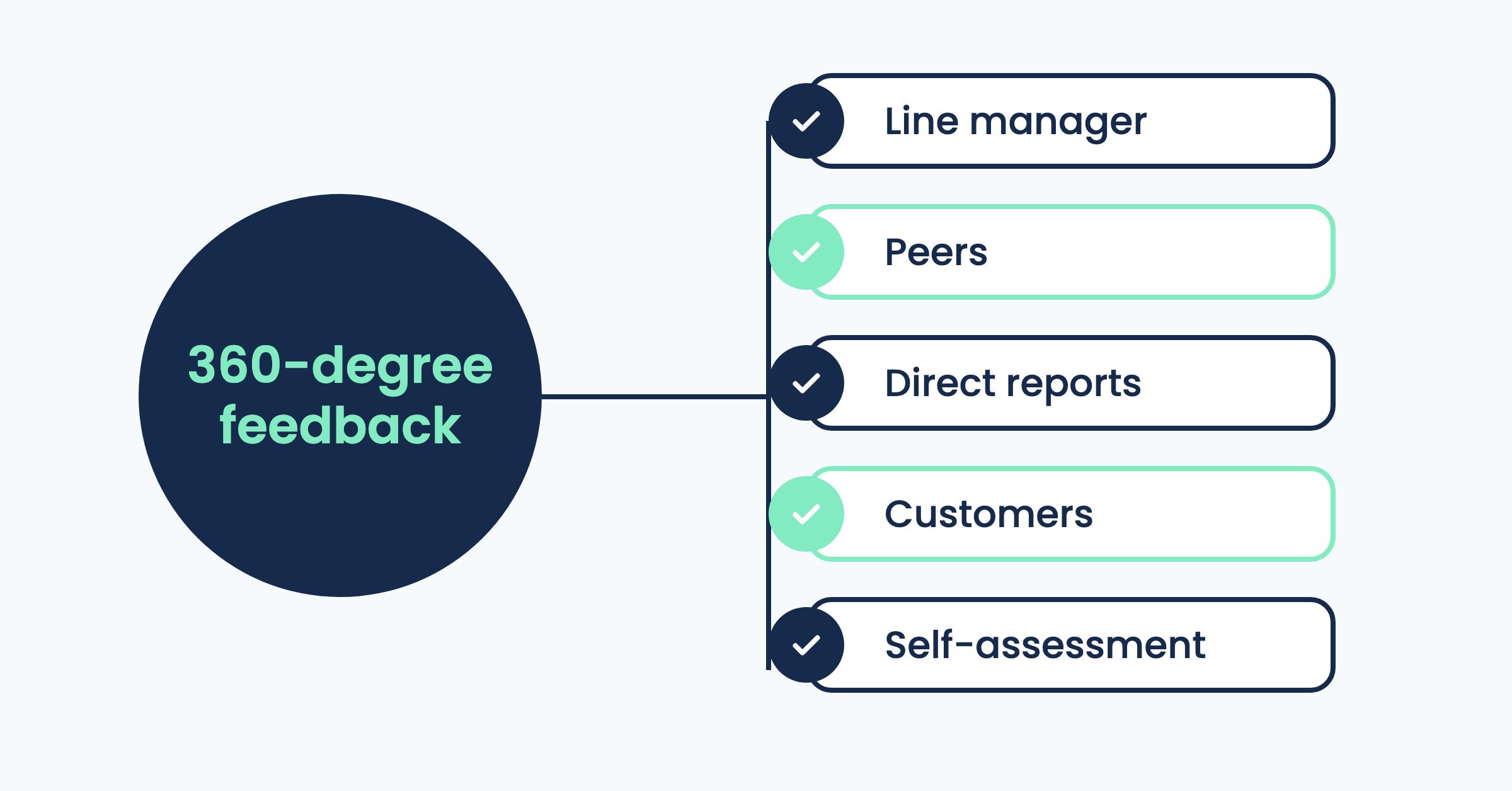
The answers are combined into a single report, usually grouped by reviewer type so that a pattern from peers is not lost inside an average.
360-degree feedback compared with a manager-only review
- Who gives feedback. 360-degree feedback: Manager, peers, direct reports, customers, self. Manager-only review: Line manager only.
- What it covers. 360-degree feedback: Behaviours, competencies and results. Manager-only review: Mostly results against objectives.
- Main strength. 360-degree feedback: Shows how someone works, not only what they deliver. Manager-only review: Simple, quick and clearly owned.
- Main weakness. 360-degree feedback: Takes more time and needs a mature feedback culture. Manager-only review: One person's blind spots shape the outcome.
- Best used for. 360-degree feedback: Development, leadership growth, team health. Manager-only review: Objective setting, pay and formal performance records.
Many organisations use both. The manager's review stays the formal record, and a 360 runs once a year to feed development plans.
Benefits and drawbacks
Benefits
- A broader, more balanced view of strengths and gaps
- Surfaces behaviours a manager rarely sees, such as how someone treats their team
- Encourages an open culture where feedback flows in every direction
- Gives employees concrete material for their development plan
- Makes performance management feel fairer and more transparent
Drawbacks
- Slow and fiddly to run on spreadsheets and email
- People may not answer honestly if they do not trust how results will be used
- Untrained reviewers give vague or inconsistent comments
- Without follow-up, people stop taking part seriously
- Poorly framed questions can turn it into a popularity contest
Look closely at the drawbacks and most of them come down to culture and process. Where people trust each other, understand the purpose and are shown how to give feedback, 360 reviews tend to deliver four things.
Self-awareness. People see how their behaviour lands with different groups, which is hard to learn from a single manager.
Motivation. Hearing specific praise from peers and direct reports is often more motivating than a rating. When development areas are framed well, people take them as a sign that the company is investing in them.
Shared accountability. When everyone's view counts, team results matter as much as individual ones, and people are more likely to help each other.
Retention. Regular, useful feedback gives people a clearer view of how they can grow in their current role, which is one of the reasons employees stay.
How to run a 360-degree review in nine steps
- Set a clear purpose. Decide whether the review is for development only or will also inform pay, promotion or other decisions, and tell people before it starts. Most organisations get more honest answers when results are used for development.
- Choose the reviewers. Agree which groups take part for each role. Five to eight reviewers per person is a common range. That is enough for patterns to show and few enough to keep the workload reasonable.
- Define what you measure. Pick a small set of competencies and behaviours, such as communication, collaboration, leadership and delivery. Write each question about observable behaviour ("shares information the team needs on time") rather than personality.
- Standardise the process. Use the same rating scale, the same questions per role and a fixed timetable. Decide how often you run it, whether annually or every six months.
- Be honest about anonymity. Group results so that no single answer can be traced, and set a minimum number of responses per group (three is common) before that group is shown. Do not promise absolute anonymity, for the data protection reasons explained below.
- Train reviewers and recipients. Show reviewers how to give specific, balanced comments. Show recipients how to read a report without fixating on one harsh remark.
- Collect and analyse the results. Compare the self-assessment with each reviewer group. The gaps between how someone sees themselves and how others see them are usually where the useful conversations start.
- Turn results into a development plan. The line manager should go through the report in a one-to-one and agree two or three specific actions with a review date.
- Review the process itself. After each cycle, ask participants what worked and adjust the questions, timing and reviewer groups.
360-degree feedback and UK GDPR
Comments and ratings about an employee are that employee's personal data, so UK GDPR applies to a 360 review like any other HR record. Three points are worth planning for.
- Subject access requests. An employee can ask to see the personal data you hold about them, which can include feedback comments. Information that identifies the reviewer is also personal data, and you have to weigh it separately before deciding what to disclose. This is why it is safer to promise confidentiality and aggregation than complete anonymity.
- Transparency. Tell employees in your privacy notice or review guidance what you collect, who sees it, what it is used for and how long you keep it.
- Retention. Set a retention period for 360 reports and delete them when it ends.
If 360 results ever feed into pay, promotion or capability decisions, explain this in advance and apply the process consistently. A decision that rests mainly on anonymous comments is hard to justify if it is later challenged.
An example: Sam, a team lead
Here is how a 360 report might summarise feedback for Sam, who leads a customer support team of six.
- Line manager (Results, leadership, communication): "Sam's team hit its response-time target every month this year. Sam keeps me well informed and raises problems early."
- Peers (Collaboration, reliability, communication): "Easy to work with and always shares updates from customers. Planning across teams could be better, as we sometimes hear about changes late."
- Direct reports (Leadership, support, delegation): "Sam is supportive and always available. Sam tends to take on the hardest tickets personally, and we would learn more if those were shared out."
- Customers (Service, communication): "Clear, quick and follows up without being chased."
- Self-assessment (All areas): "I think my planning is strong. I would like to get better at coaching."
The manager's view on its own would have been almost entirely positive. Peers point to cross-team planning, and Sam's self-assessment rates planning as a strength, so that gap is worth discussing. Direct reports add something the manager could not see: Sam's habit of handling difficult work alone is limiting the team's development. A sensible development plan for Sam would focus on delegating complex tickets and sharing plans with neighbouring teams earlier.
How Kolay IK can help UK companies
Collecting feedback from several people, chasing responses and combining the results by hand is where most 360 programmes stall. There are three ways we can help.
- Design your review process with our experts. Our performance review consultancy team works with you on the questions, the reviewer groups, the timetable and how results turn into development plans.
- Run it on our software. Kolay IK's performance review software runs competency-based, goal-based and 360-degree reviews from ready-made templates, sends reminders and turns the answers into a report for each employee.
- Cover your team in Türkiye too. If you have a branch or team in Türkiye, we can design and run its performance reviews locally and report the results to you in the language and format you need.
Book a demo to see how a 360 review would work for your team.
Sources
Checked on 25 November 2026 against the official texts and guidance below.
- UK GDPR, Article 15: right of access (legislation.gov.uk)
- Data Protection Act 2018, Schedule 2, paragraph 16: information about other individuals (legislation.gov.uk)
- UK GDPR, Article 13: information to be provided to the data subject (legislation.gov.uk)
- UK GDPR, Article 5: principles, including storage limitation (legislation.gov.uk)
- Data protection and your business (GOV.UK)